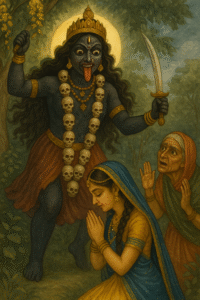
Kuṭilā’s Return to Yāvat
After being deceived by Kṛṣṇa’s clever disguise as her brother Abhimanyu, Kuṭilā returned to Yāvat in great excitement, convinced she had gathered undeniable proof of Rādhā’s secret meetings. She rushed into her mother Jaṭilā’s room, panting with triumph.
“Mother! Mother!” she cried. “Today I caught them! I saw Rādhā’s pearl necklace and Kṛṣṇa’s flower garland entwined together in the same place. What further proof do we need?”
Jaṭilā’s eyes widened. “Really? You mean that wicked Kṛṣṇa? Wait until Abhimanyu returns — we shall teach Him and that girl a lesson they will never forget!”
But before Jaṭilā could act, she heard footsteps in the courtyard. It was “Abhimanyu” himself — or so she thought. In truth, it was still Kṛṣṇa, dressed perfectly like her son.
The Mother’s Fury
Jaṭilā stormed out and shouted, “You shameless boy! How dare You come here again? Have You no fear of elders? Get out before I call the villagers!”
Kṛṣṇa, hiding His smile, bowed respectfully and said in Abhimanyu’s exact voice, “Mother, what has happened? Why are You so angry? It’s me — Your son.”
“Liar!” she screamed. “Do You think You can fool me again? You’ve been exposed already!”
To convince her further, Kṛṣṇa said solemnly, “Mother, I have just returned from Kaṁsa’s court in Mathurā. I went there to inform the king of Nanda’s mischief and Kṛṣṇa’s tricks. Kaṁsa is now sending soldiers to arrest them!”
Jaṭilā’s anger paused for a moment. “Really?” she said doubtfully.
Kṛṣṇa nodded gravely. “Yes, Mother. But please, let Me go inside and speak with My wife, Rādhā. I must tell Her the news myself.”
Still muttering, Jaṭilā reluctantly allowed Him to enter, warning, “Don’t think I’ll fall for any of Your magic. I’ll keep guard right here!”
The Real Abhimanyu’s Arrival
Not long after, the real Abhimanyu returned from the market, carrying a bundle of grass for his cows. When Jaṭilā saw him, she grew furious. “You dare to return again, you two-faced scoundrel! Didn’t I tell you to stay away from my house?”
Abhimanyu was stunned. “Mother! What are you saying? It’s me — Abhimanyu, your son!”
Jaṭilā shouted, “Enough! You can’t fool me with your tricks. You think I can’t see through Kṛṣṇa’s disguise?”
Before Abhimanyu could respond, Kuṭilā joined in, waving her arms. “Yes! Throw him out, Mother! Don’t let that black-faced deceiver enter again!”
They both began hurling clods of cow dung and chaff at him, screaming insults. Poor Abhimanyu ran for his life, utterly bewildered, while the whole village laughed at his humiliation.
Inside the Chamber of Love
Meanwhile, inside the house, Kṛṣṇa was safely seated beside Rādhārāṇī in Her private chamber. The door was bolted, and the windows were drawn. The two lovers smiled at each other amidst the soft glow of oil lamps. The air was filled with the fragrance of sandalwood and jasmine.
Outside, the noise of Jaṭilā and Kuṭilā’s shouting grew faint, and the world seemed to disappear. Within that small room, only divine love existed.
Kṛṣṇa whispered playfully, “My dear Rādhe, today I rode here on the head of your husband and entered your house under the protection of your mother-in-law. Tell Me, who else can manage such a feat?”
Rādhā laughed softly. “And now you have caused your poor friend Abhimanyu to be chased from his own home. Truly, Your mischief knows no limit.”
They both smiled, and the whole of Yāvat seemed to glow with their joy.
Jaṭilā’s Humiliation
When the shouting subsided, Jaṭilā and Kuṭilā, feeling satisfied that they had protected their honor, finally went inside the house. But when they entered Rādhā’s room, what they found took their breath away.
Rādhārāṇī was sitting quietly, spinning thread, Her face serene and radiant. Kṛṣṇa was nowhere to be seen. The air was still heavy with divine fragrance, but no trace of any intruder remained.
Jaṭilā’s eyes darted around suspiciously. “Where is that black boy? He was here just now!”
Rādhā looked up calmly. “Mother, you must have been dreaming again. I have been here the whole time, weaving garlands for you and my husband.”
Kuṭilā tried to speak, but her tongue stumbled. “B-but I saw—”
Lalitā, standing beside Rādhā, interrupted, “Yes, you saw how your imagination runs wild again. Come, take some rest.”
Jaṭilā muttered something under her breath and left, feeling utterly confused.
The Playful Conclusion
Outside, the villagers were laughing. They had seen Abhimanyu running down the road covered in cow dung, shouting, “My own mother attacked me!”
Jaṭilā, embarrassed beyond words, ordered everyone to keep silent. But from that day on, she stopped interfering in Rādhārāṇī’s affairs, convinced that some divine mystery was protecting Her.
And thus, Yogamāyā once again arranged everything perfectly — exposing pride, protecting purity, and increasing the sweetness of the Lord’s pastimes.
Lessons to Be Learned
- The Lord’s plans are beyond human logic. Even the cleverest attempt to obstruct Him becomes part of His divine play.
- Those who act with envy and suspicion only humiliate themselves. Jaṭilā and Kuṭilā’s crookedness turned upon them.
- The Lord hides Himself from the proud but reveals Himself to the pure. Rādhā’s serenity was Her greatest protection.
- In divine love, every circumstance becomes an opportunity for Kṛṣṇa’s mercy to unfold.
Reflections
This pastime reveals the beauty of divine intelligence and the futility of worldly cunning. In our own lives, we sometimes behave like Jaṭilā or Kuṭilā — suspicious, controlling, and fearful. But Kṛṣṇa’s world is governed not by control but by love.
When we trust His will, even confusion becomes revelation. When we resist Him, even knowledge becomes blindness. Rādhā teaches us that the best defense in life’s trials is simple, unwavering devotion.
Let our hearts become like Her chamber — locked from the world, open only to Kṛṣṇa.
Origin of the Story
Adapted from “Vraja-līlā – Part 2” by Deena Bandhu dāsa (Yāvat Part One), derived from Śrīla Viśvanātha Cakravartī Ṭhākura’s Camatkāra-candrikā and related Gauḍīya Vaiṣṇava texts