The Call of Change
The morning sun rose softly over the meadows of Vraja. The Yamunā glistened like a river of silver, and the air was filled with the sweet songs of cuckoos. Yet in Yāvat, the sound of quiet weeping could be heard from the inner courtyard.
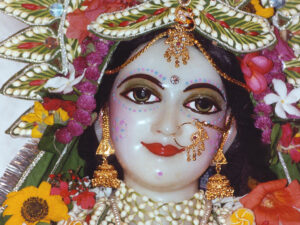
Śrīmatī Rādhārāṇī sat beneath a kadamba tree, surrounded by Her sakhīs — Lalitā, Viśākhā, and the others — their eyes red with tears. The time had come for Her to leave Yāvat and move nearer to Nandagrāma, where Śrī Kṛṣṇa resided.
Paurnamāsī Devī’s prophecy had now come true. The pastimes of Yāvat — those secret meetings, hidden smiles, and tears of separation — had fulfilled their divine purpose.
Lalitā spoke softly, “O Rādhe, this garden has witnessed every sigh of Your heart. The vines that bloomed here will fade without Your touch.”
Rādhā replied gently, “No, Lalite. They will not fade. The flowers of Yāvat bloom not from sunlight but from remembrance. As long as Kṛṣṇa’s name echoes here, these gardens will remain alive.”
She looked around one last time — the well where She once drew water and saw His reflection, the gate where He once came disguised as a priest, the window where the parrot Śuka brought His messages. Every corner carried a story, every stone held a tear.
Jaṭilā’s Change of Heart
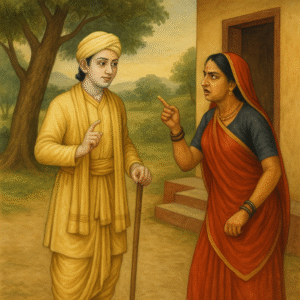
To everyone’s surprise, even Jaṭilā stood silently nearby, her head bowed. Gone was her suspicion, her sharp tongue. Time and mercy had softened her heart.
She approached Rādhā hesitantly. “Child,” she said, “forgive my ignorance. I feared for this family’s honor, yet You were its true honor all along. Wherever You go, may peace follow.”
Rādhā bowed respectfully, Her eyes glistening. “Mother, your care protected Me. If you scolded Me, it was out of love. May this home always remain blessed.”
Kuṭilā too came forward, folding her hands. “Sister,” she said softly, “ever since that night, I have seen the truth. You are not of this world. Please forgive my envy.”
Rādhā embraced her gently. “O Kuṭilā, envy dies where love begins. May you always remember Kṛṣṇa — for to remember Him is to know Me.”
The Farewell Blessings
The sakhīs helped Rādhā prepare for the journey. They adorned Her with a blue sari embroidered with gold thread, placed fresh jasmine in Her hair, and tied around Her neck the pearl necklace that Kṛṣṇa Himself had given.
Paurnamāsī arrived with a serene smile. “Child,” she said, “Yāvat has served its purpose. Through Your patience, the world has learned the beauty of longing. Now go to Nandagrāma, where joy shall follow sorrow, and reunion shall crown separation.”
Rādhā bowed at her feet. “O Grandmother, You weave the threads of destiny. May I forever remain an instrument in Your hands.”
Then Paurnamāsī lifted her hands and blessed the entire village:
“Let this place be eternally remembered.
Let every pilgrim who walks here feel the fragrance of Rādhā’s love.
Let every tear shed here become a pearl of devotion.
Yāvat shall never be forgotten, for here love ripened through waiting.”
The Journey
As the sun rose higher, a small procession began. The sakhīs walked beside Rādhā, their veils fluttering in the breeze. Villagers watched in reverent silence. The cows stopped grazing, birds paused in their songs, and even the trees bent slightly as if offering their respects.
When They reached the edge of the village, Rādhā turned back for one final glance. Her eyes fell upon the terrace where She had once watched the clouds, the path where Kṛṣṇa had come in disguise, and the garden where Their secret laughter still echoed.
“Farewell, O Yāvat,” She whispered. “You were My prison and My paradise, My teacher and My mirror. In Your walls, I learned the secret of love — that even absence is a form of union.”
The wind carried Her words like a prayer through the forest.
The Reunion at Nandagrāma
When the procession reached the outskirts of Nandagrāma, a familiar sound broke the stillness — the gentle melody of Kṛṣṇa’s flute.
Rādhā stopped, Her heart leaping. From behind the trees appeared Kṛṣṇa, His smile radiant, His eyes glistening with love.
“Rādhe,” He said softly, “You have come at last. Even the Yamunā could not flow without You. The whole of Vraja has waited for this day.”
Rādhā lowered Her gaze. “It was not I who came — it was love that led Me here.”
Kṛṣṇa extended His hand. “Then let that love now rest where it belongs — not in waiting, but in union.”
And as Their hands met, the whole of Vṛndāvana seemed to awaken in joy. The cows bellowed, the peacocks danced, and the sky blazed with golden light.
The Hidden Meaning
Yāvat represents the stage of separation in the devotee’s journey, and Nandagrāma represents union.
The soul, like Rādhā, must first learn patience, humility, and faith within the house of trials before it can enter the home of divine joy.
Leaving Yāvat symbolizes the soul’s surrender — the moment when it realizes that love for Kṛṣṇa is not about seeking pleasure, but about embracing service in all circumstances.
Lessons to Be Learned
- Every separation is preparation for a greater meeting.
- The heart becomes holy through endurance and faith.
- Forgiveness transforms even those once hardened by envy or fear.
- True love means to remember God not only in joy but in struggle.
Reflections
Rādhā’s farewell to Yāvat is not merely a departure from a place but a passage of the heart. Each of us has our own “Yāvat” — a stage of waiting, discipline, and apparent distance from divine joy.
But those are the places where our devotion matures. Just as Rādhā’s love became eternal through patience, so our spiritual life deepens through perseverance.
When at last we “depart” from those inner Yāvats — from restlessness, doubt, and pride — we find that Kṛṣṇa’s flute has been calling us all along. Then we realize, like Rādhā, that the Lord never truly left; He was simply waiting for us to be ready to see Him.
Prayer
O Śrīmatī Rādhārāṇī, who turned separation into sacred joy, please teach me to walk patiently through my own Yāvat.
O Śrī Kṛṣṇa, whose flute calls every heart home, please let me hear Your song even in the storms of waiting.
May I never curse the seasons of distance but embrace them as Your preparation for union.
And when my heart is ready, O Lord, take me from my Yāvat to my Nandagrāma — from longing to love, from shadow to light, from myself to You.
Origin of the Story
Adapted from “Vraja-līlā – Part 2” by Deena Bandhu dāsa (Yāvat Part One, “Farewell to Yāvat”), based on the Camatkāra-candrikā of Śrīla Viśvanātha Cakravartī Ṭhākura and the traditional Gauḍīya Vaiṣṇava narrations of Rādhā’s journey from separation to reunion. Retold in the devotional language and spirit of Śrīla A. C. Bhaktivedanta Swami Prabhupāda.