The Play of Destiny in Bhandīravana
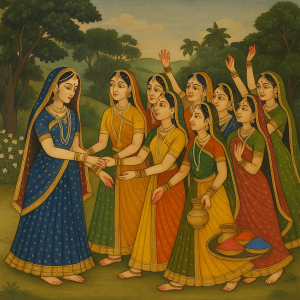
One day, near the sacred forest of Bhandīravana, Kṛṣṇa and His cowherd friends were playing on the bank of the Yamunā. The air was sweet with the scent of blooming lotus flowers, and the peacocks danced in delight. Meanwhile, in the same grove, Rādhārāṇī and Her sakhīs were engaged in picking flowers and weaving garlands for worship.
By the mysterious arrangement of Yogamāyā, Rādhā and Kṛṣṇa’s eyes met. The entire universe seemed to pause in reverence for that moment. The breeze stopped, the birds fell silent, and even the Yamunā’s ripples froze in still devotion.
The sakhīs, understanding the divine purpose, smiled knowingly. Lalitā whispered, “This meeting is not ordinary—it is arranged by the gods themselves.”
The Arrival of Brahmā
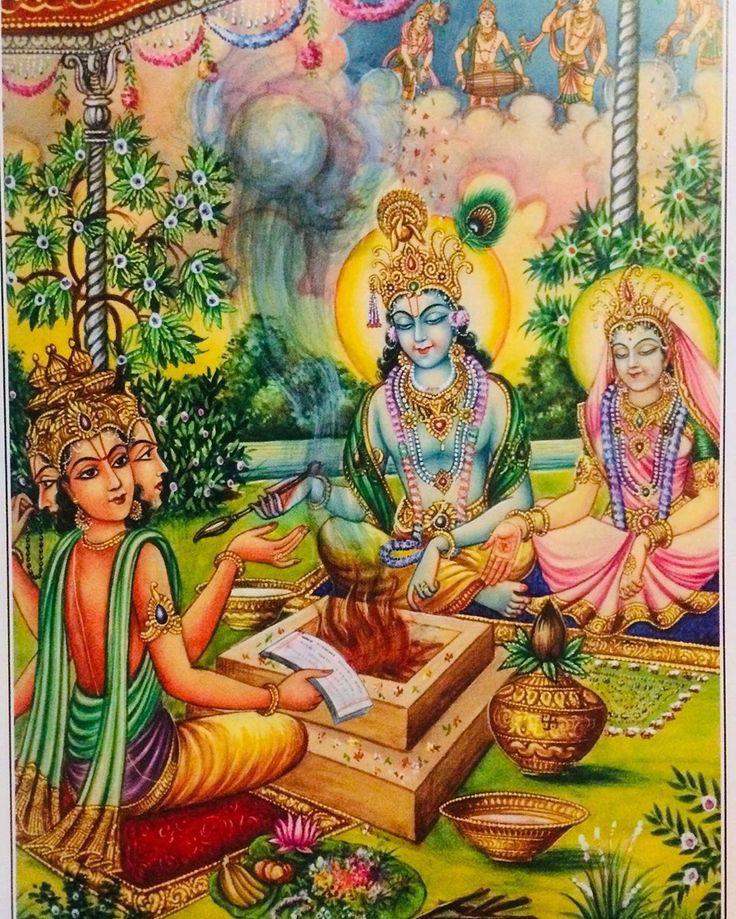
At that moment, Lord Brahmā, the creator of the universe and the first being born from Kṛṣṇa’s own energy, descended upon a celestial swan. In his four hands, he carried sacred items for a marriage ritual: a conch, water pot, garland, and scriptures. Bowing before Them, he said, “O Supreme Lord and O Queen of devotion, I have been commanded by destiny to perform Your divine wedding here in this forest.”
Rādhā looked at Kṛṣṇa shyly, and Kṛṣṇa smiled, holding out His lotus hand. The sakhīs arranged flowers into a natural canopy, and the forest became filled with divine radiance. Even the demigods gathered unseen in the sky to witness the sacred event.
The Marriage Ceremony
Brahmā chanted the Vedic mantras, sanctifying the union of the Divine Couple. He sprinkled holy water from his kamandalu upon Rādhā and Kṛṣṇa, and garlands of celestial flowers rained from above.
Kṛṣṇa placed a garland around Rādhā’s neck and said, “From this day, You are My eternal consort, the Queen of My heart.” Rādhā smiled gently and placed Her garland upon Him in return, saying, “And You, My beloved, are My eternal Lord. Without You, I do not exist.”
All of Vṛndāvana rejoiced. The trees bowed, the rivers hummed sweetly, and the wind carried the fragrance of divine love. Brahmā, with folded hands, prayed, “May this sacred marriage remain forever beyond the comprehension of mortals, for it is the eternal union of the soul and the Supreme.”
The Eternal Nature of Their Marriage
Though outwardly this marriage took place only once in the visible world, it eternally exists in the spiritual realm of Goloka Vṛndāvana. There, every moment is a festival of Their love, and every breeze carries the music of Their laughter.
The marriage in Bhandīravana is symbolic: Kṛṣṇa represents the Supreme Truth, and Rādhā represents the highest devotion. Their union signifies that God and His pure devotee are inseparable—love and the beloved are one.
Reflection
This divine marriage teaches that the ultimate purpose of all existence is the reunion of the soul with the Supreme through love. Śrīla Prabhupāda wrote that bhakti-yoga is the sacred wedding of the individual soul and Kṛṣṇa—the binding of the heart through devotion.
In Rādhā and Kṛṣṇa’s union, we see the perfection of spiritual life: service that becomes love, and love that becomes eternity. When our hearts become pure and humble, we too may witness this divine wedding within ourselves—the moment when the soul surrenders completely and finds everlasting peace in Kṛṣṇa.
Let us pray:
“O Śrīmatī Rādhārāṇī and Śrī Kṛṣṇa, please allow me to serve at Your lotus feet. Let my heart be purified by Your union, and let my soul forever celebrate the marriage of love and truth within the temple of devotion.”