The Slaying of Ariṣṭāsura
One day, in the pastoral lands of Vṛndāvana, the cowherd boys and cows were grazing happily when a terrifying roar echoed across the fields. The demon Ariṣṭāsura, sent by Kaṁsa, had appeared in the form of a massive bull. His eyes were red with fury, his hooves struck the ground with thunderous force, and his horns gleamed like sharpened weapons.
Seeing this monstrous bull charging toward the village, the Vrajavāsīs ran in fear. The cows scattered, and the earth trembled beneath his weight. The gopīs cried out, “Kṛṣṇa! Save us!”
Kṛṣṇa, who was nearby playing with His friends, stepped forward calmly. “Do not fear,” He said, “this bull is no ordinary creature—he is a demon in disguise. I shall protect you.”
Ariṣṭāsura, bellowing with rage, rushed toward Kṛṣṇa. The Lord caught him by the horns, hurled him to the ground, and pierced his body with His bare hands. The bull fell lifeless, and the earth was purified by the Lord’s touch.
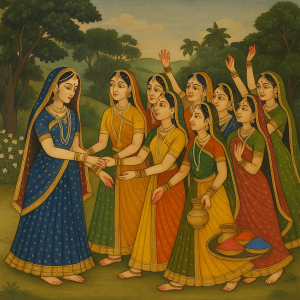
But among the onlookers were Śrīmatī Rādhārāṇī and Her sakhīs, who observed the scene with both awe and humor. Lalitā-sakhī whispered to Rādhā, “Our Kṛṣṇa is a great hero indeed—but He has touched a bull, the symbol of religion! He must purify Himself before He can come near us again.”
Rādhārāṇī’s Divine Play
Hearing this teasing remark, Rādhārāṇī smiled mischievously and said, “Yes, Lalitā, you are right. Though He has killed a demon, He has also touched a bull, and for that, He must atone. Let Him bathe in all the holy rivers to cleanse Himself before approaching us.”
Kṛṣṇa, amused by Her playfulness, replied, “My dear Rādhe, the holy rivers themselves reside within Me. Why should I need to go elsewhere? But if You insist, I shall make a new river right here and bathe in it.”
Creation of Śyāma-kuṇḍa
Saying this, Kṛṣṇa struck the ground with His heel. Immediately, the earth opened, and from that spot, a beautiful lake appeared—its waters dark and shining like His own complexion. The celestial rivers—Gaṅgā, Yamunā, Sarasvatī, Godāvarī, Sindhu, Kāverī, and others—manifested before Him, offering prayers and entering the lake to fill it with their sacred waters.
Kṛṣṇa bathed in the lake and declared, “Now I am purified! This pond shall be known as Śyāma-kuṇḍa, and whoever bathes here will be freed from all sins and attain love for Me.”
Rādhārāṇī’s Lake Appears
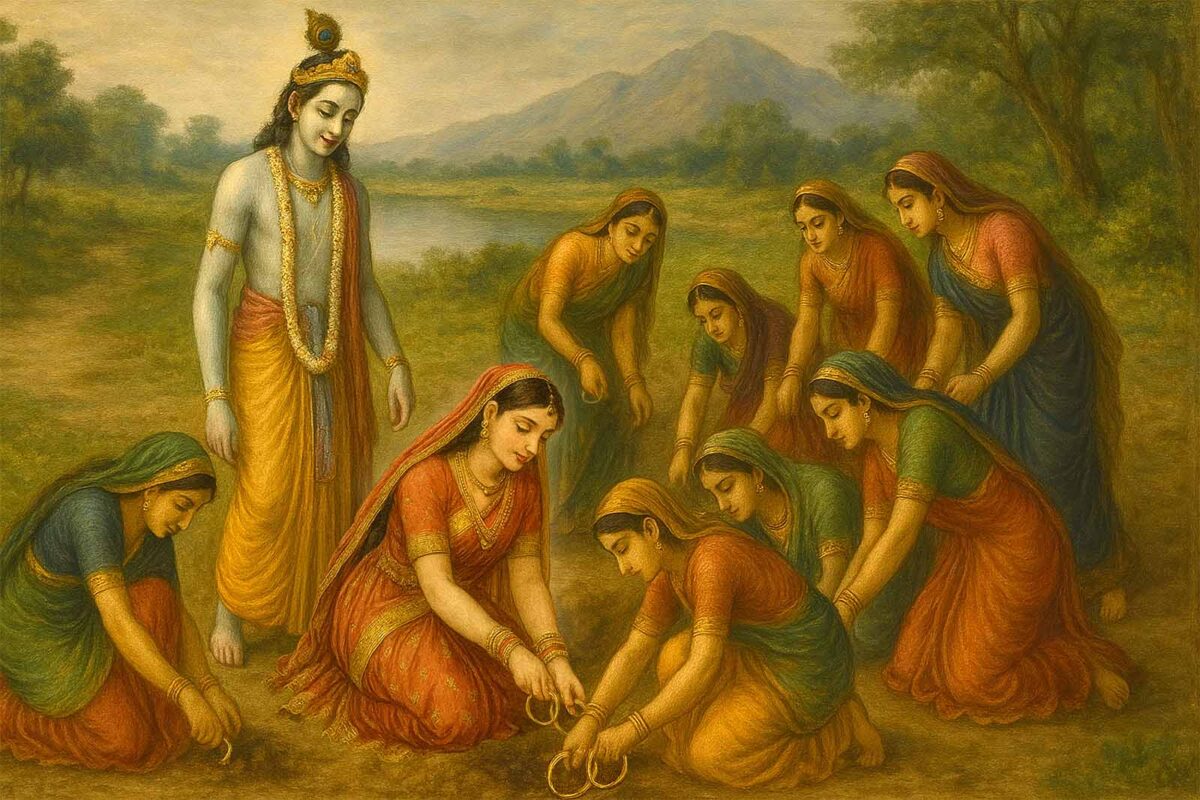
Rādhārāṇī, not to be outdone in divine play, laughed softly and said, “You may have Your lake, Śyāmasundara, but I shall create one more beautiful.” She and Her sakhīs took off their bangles and began digging a pond beside Kṛṣṇa’s, using their delicate hands.
When their small palms grew tired, Kṛṣṇa smiled and said, “My dear Rādhe, let Me fill Your lake with water from Mine.”
But Rādhā replied, “No, My Lord. I shall not take water from Your pond tainted by the killing of a bull. My lake shall be filled with pure water of its own accord.”
Hearing this, the presiding goddesses of all the sacred rivers appeared before Rādhārāṇī, offering obeisances. They said, “O Queen of devotion, we wish to enter Your lake as well, for You are the origin of all sacredness.”
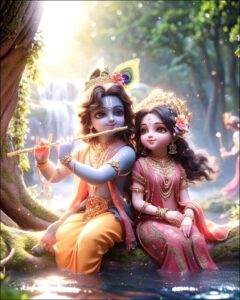
With Rādhā’s consent, they entered Her pond, filling it with divine, crystal-clear water. The gopīs sang joyfully, and the two lakes—Śyāma-kuṇḍa and Rādhā-kuṇḍa—shone side by side like twin jewels on the breast of Vraja.
The Union of the Lakes
Kṛṣṇa, touched by Rādhā’s devotion, embraced Her and said, “From this day, these two lakes shall be one. Whoever bathes in Rādhā-kuṇḍa will receive the same blessing as bathing in all holy places combined and will attain love for Me alone.”
Then, with a gesture of love, He extended Śyāma-kuṇḍa so that the waters of both lakes joined together. The gopīs danced, the gods showered flowers from the sky, and the very air of Vṛndāvana became fragrant with divine joy.
The Spiritual Meaning of the Kuṇḍas
Rādhā-kuṇḍa represents the supreme love and compassion of Śrīmatī Rādhārāṇī, while Śyāma-kuṇḍa represents Kṛṣṇa’s reciprocal affection. To bathe in Rādhā-kuṇḍa is to enter the heart of divine love itself—to be cleansed of all selfish desires and to awaken pure devotion to Kṛṣṇa.
Śrīla Raghunātha Dāsa Gosvāmī, who resided by Rādhā-kuṇḍa in his later life, prayed:
“May I live by the side of Śrī Rādhā-kuṇḍa, which is the most exalted of all places, because it is filled with the nectar of Śrīmatī Rādhārāṇī’s love for Kṛṣṇa.”
Reflection
This divine pastime teaches that Kṛṣṇa delights in the loving superiority of His devotees. Even when He performs great deeds, He takes joy when Rādhārāṇī playfully triumphs over Him with Her love. In the heart of the devotee, both lakes must exist—the lake of Kṛṣṇa’s mercy and the lake of Rādhā’s devotion, joined together through service and remembrance.
Let us pray:
“O Rādhā-Kṛṣṇa, let my heart become a small pond of devotion, filled with the waters of humility and love. May I always bathe in the remembrance of Your names and pastimes, and one day receive the dust of Rādhā-kuṇḍa upon my head.”