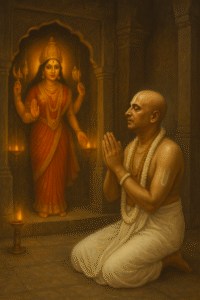
Though Raicharan had inherited great wealth and property, his heart remained detached and compassionate. He ruled not as a master, but as a servant of God entrusted with the care of His children. His tenants revered him, not out of fear, but out of love and respect.
Whenever disputes arose among villagers, Raicharan listened patiently and resolved them with fairness. He treated everyone equally, whether rich or poor, Brahmin or laborer. His words were soft, but his principles firm. Justice was his religion, and compassion its expression.
During the harvest season, he would personally visit the fields. Seeing the hard labor of the peasants, he often distributed a portion of his own share among them, saying, “The sweat that waters these crops belongs to you as much as to me.”
In times of famine or flood, when the poor had nothing to eat, he would open his granaries and say to his servants, “Distribute freely. These stores are for God’s children.” He would even sell his ornaments to relieve their distress.
But even amid the duties of a landlord, his heart increasingly turned to divine remembrance. In the evenings, he would sit on the verandah, listening to kīrtana drifting through the still night air. His eyes would fill with tears. “Ah,” he would whisper, “the real wealth of life is not gold or land, but the sweetness of the Lord’s name.”
The people began to say, “Our landlord is not of this world. He rules with the heart of a saint.”
Reflection
Śrīla Prabhupāda explained that true leadership means service — not exploitation.
Raicharan, though born into privilege, saw himself as a caretaker of God’s property. This is the hallmark of a Vaiṣṇava: humility in power, and compassion in authority.
In the modern world, wealth often becomes a chain that binds the soul. But for the pure-hearted, it becomes an instrument of mercy. Raicharan used his possessions not for pride, but for paropakāra — the welfare of others.
His life teaches that we can be spiritual even in worldly duties. When we manage our responsibilities as seva, as an offering to God, our work becomes worship.
Let us remember: the true landlord is one who rules his heart with love, his home with devotion, and his people with kindness.
Such a person reflects the divine kingship of Kṛṣṇa Himself — who governs not by force, but by affection.
Source:
All content from The Life of Love: Biography of Śrī Śrīmat Rādhā-Ramaṇa Caraṇa Dāsa Deva
by Dr. O.B.L. Kapoor (Ādikeshava Dāsa), Sarasvatī Jayashrī Classics / Paramārtha Prakāśana, Vṛndāvana, 1993.