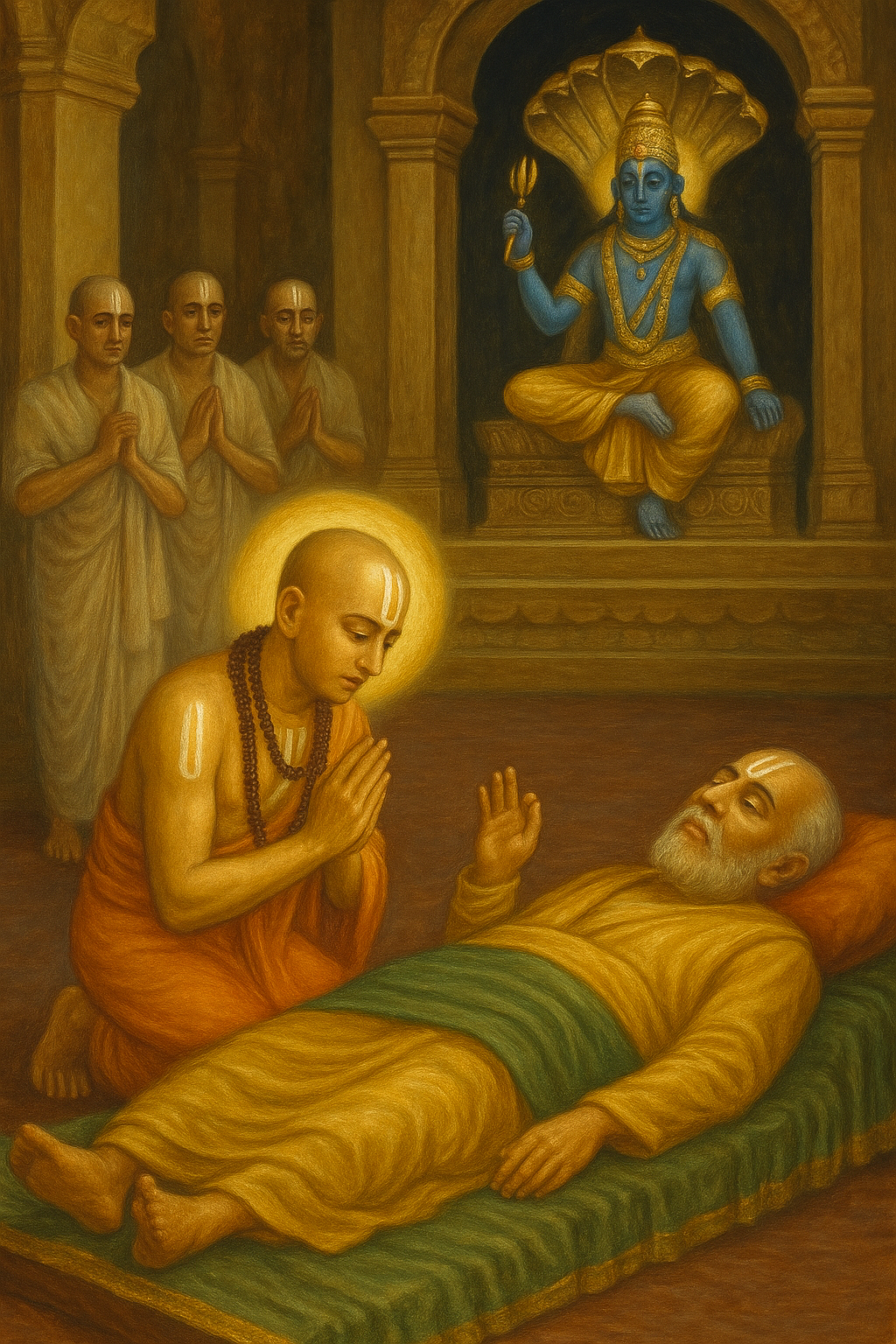
At that same time in Śrī Raṅgam, far to the south of Kañcīpuram, the great devotee and teacher Śrī Yamunācārya lay on his deathbed. Surrounded by his disciples, he was absorbed in meditation on the lotus feet of Lord Ranganātha, the Supreme Lord reclining on the serpent Ananta Śeṣa.
His followers wept softly, for they knew their beloved master was soon to depart. Yamunācārya’s eyes were half-closed, his face serene, his lips moving gently as he chanted the holy names of the Lord. At intervals, he would open his eyes and whisper words of encouragement to the devotees at his side.
“My children,” he said, “never forget that the goal of life is loving service to Lord Nārāyaṇa. Everything else is secondary. Protect the path of bhakti, and serve the Vaiṣṇavas with humility.”
At that moment, a message arrived from Kañcīpuram. The disciples learned that the young scholar Rāmānuja, whose brilliance and devotion were already renowned, was on his way to Śrī Raṅgam to seek Yamunācārya’s blessings. Joy filled their hearts, for they knew that their master’s wish was to see the one destined to continue his mission.
But the Lord’s plan was different. Before Rāmānuja could reach Śrī Raṅgam, Yamunācārya peacefully left his mortal body. The temple bells rang softly as the devotees wept and sang hymns in his honor. They carried his body to the temple of Lord Ranganātha, placed him before the Deity, and prayed for his soul’s eternal service in the spiritual world.
Meanwhile, Rāmānuja, unaware of what had happened, was hastening toward Śrī Raṅgam. When he arrived and entered the temple, he saw Yamunācārya’s lifeless body lying before the Lord. Overcome with emotion, he fell to the ground, tears streaming from his eyes.
He bowed his head and prayed, “O master of the Vaiṣṇavas, though I have never met you, your mercy has guided me. Please bless me that I may fulfill your unfinished work.”
As he gazed upon the great saint’s body, he noticed something wondrous—three fingers on Yamunācārya’s right hand were tightly closed. The devotees around were puzzled. Rāmānuja inquired, “Has anyone explained why his hand remains so?”
One of the senior disciples replied, “Before he passed away, our master made three solemn wishes, but he left before speaking them aloud. Perhaps the Lord has reserved them for you.”
Hearing this, Rāmānuja bowed before the saint’s feet and said, “If it be the will of the Lord, may these be his wishes: First, that I shall write a clear commentary on the Vedānta-sūtras, establishing the doctrine of devotion to the personal God, Śrī Nārāyaṇa. Second, that I shall perpetuate the memory of the divine sage Parāśara, who revealed the truths of the Viṣṇu Purāṇa. And third, that I shall spread the message of bhakti so that all souls, regardless of birth or caste, may attain the Lord’s grace.”
As soon as he uttered these vows, the three fingers of Yamunācārya’s right hand slowly opened. The devotees gasped in awe, realizing that the soul of their master had heard and accepted Rāmānuja’s promise.
Rāmānuja wept in reverence, praying, “O revered Ācārya, from this moment, I am your servant. Through your mercy, I shall fulfill your desires.”
From that day onward, the spirit of Yamunācārya lived in the heart of Rāmānuja. The mission of spreading pure devotion to the Supreme Lord had passed from one divine soul to another, ensuring the unbroken flow of bhakti for generations to come.
Lessons to Be Learned
- The spiritual master lives through his mission.
Though Yamunācārya departed physically, his purpose continued through Rāmānuja’s surrender. True discipleship means carrying forward the master’s heart and vision. - Devotion transcends time and distance.
Even though they never met in the body, the connection between Yamunācārya and Rāmānuja was spiritual and eternal, guided by divine will. - Vows taken for service become sacred.
Rāmānuja’s three promises shaped his life’s work, reminding us that commitments made in service to the Lord are not burdens—they are blessings.
Reflections
The parting of Yamunācārya is a moment of sacred inheritance. It teaches that the chain of devotion is never broken. When one servant departs, another rises by divine arrangement to carry the torch. Śrīla Prabhupāda wrote, “The spiritual master may disappear, but his instructions remain forever.”
Rāmānuja’s vow before Yamunācārya’s body was more than an act of faith—it was a covenant between generations of devotion. In that moment, the living current of bhakti flowed from one pure soul to another, ensuring that the world would continue to receive the message of divine love.
Source:
The Life of Ramanujacarya by Naimisaranya Dāsa, Chapter Three: “The Passing of Yamunācārya.” Bhaktivedanta Book Trust, 1986.


