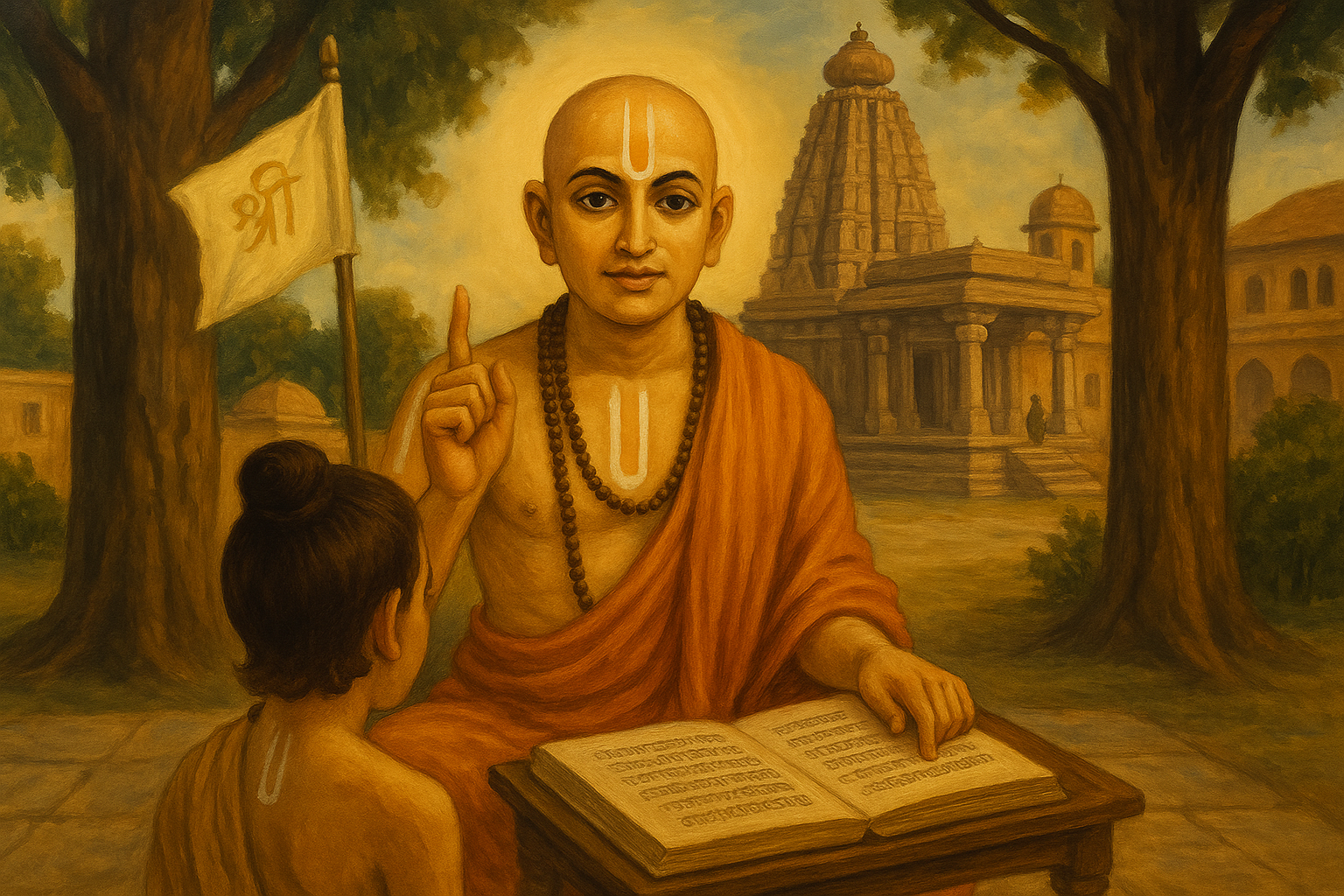
In the heart of Kañcīpuram, the school of the renowned scholar Yādavaprakāśa was filled each morning with the rhythmic sound of recited Sanskrit verses and the rustle of palm-leaf manuscripts. Learned brāhmaṇas, young disciples, and visiting scholars gathered there to study Vedānta, logic, and the Upaniṣads. Among them sat Rāmānuja—radiant, humble, and attentive, his heart burning with both reverence and longing for truth.
Yādavaprakāśa, proud of his reputation, enjoyed having such a gifted pupil. Rāmānuja’s memory and understanding were extraordinary, and soon he became the teacher’s most brilliant student. But within that brilliance lay a quiet tension—Rāmānuja’s devotion to the Lord clashed with his teacher’s cold intellectualism.
One day, during a discourse on the Chāndogya Upaniṣad, Yādavaprakāśa explained that the Supreme Brahman was impersonal, devoid of qualities, and without form. As an example, he cited the verse describing the Lord’s eyes as “like the lotus.” He said, “This verse must not be taken literally. It is only a poetic metaphor meant to express that the Supreme has no eyes, no limbs, no qualities. Brahman is formless, without color, without personality.”
At these words, Rāmānuja felt pain in his heart. Unable to remain silent, he folded his hands and spoke gently, “Revered master, forgive me for speaking, but may I share what my heart feels? If the scriptures compare the Lord’s eyes to lotus petals, is it not because they are indeed beautiful and filled with compassion? Why should we deny the reality of His transcendental form when the śāstras themselves glorify it?”
The students turned their heads toward the young man. The room fell silent.
Yādavaprakāśa frowned, his pride stung. “You are too young to understand such subtleties, Rāmānuja,” he said sharply. “These descriptions are figurative. The Absolute cannot possess form, for form implies limitation.”
But Rāmānuja bowed respectfully and replied, “Master, if form implies limitation, then what of His unlimited mercy and beauty? Can they be formless? The śāstras say that the Lord walks, though He has no material legs; that He sees, though His sight is beyond human eyes. Surely, His form is transcendental, not material. It is through this divine form that devotees find love and shelter.”
The teacher’s face hardened. “You speak with sentiment, not with philosophy,” he said coldly. “Control your emotions. True wisdom lies in detachment, not affection.”
Rāmānuja lowered his eyes and said softly, “Then I pray that I may remain a fool—if to know the Lord means to forget His mercy.”
The class ended abruptly. Yādavaprakāśa dismissed the students, but in his heart envy began to grow. He sensed that this disciple’s simple devotion carried a power greater than his own scholarship.
From that day onward, he began to look upon Rāmānuja with suspicion and discomfort. Yet, Rāmānuja continued to serve him faithfully—massaging his feet, preparing his seat, and following him in study tours. His humility only magnified his teacher’s unease, for the brilliance of a pure heart silently exposes the emptiness of pride.
Lessons to Be Learned
- Knowledge without devotion becomes dry and proud.
True wisdom lies not in denying the Lord’s personality but in understanding His transcendental nature filled with compassion and beauty. - A pure heart perceives what intellect cannot.
While scholars argue about the Lord’s form, the devotee feels His presence and experiences divine reality. - Humility is the ornament of wisdom.
Though misunderstood, Rāmānuja never disrespected his teacher. His meekness became his strength, for the Lord dwells only in a humble heart.
Reflections
This story reflects the eternal struggle between intellect and devotion. Śrīla Prabhupāda often said, “Philosophy without religion is dry speculation, and religion without philosophy is mere sentiment.” Rāmānuja embodied both—his heart full of love, his intellect anchored in scripture.
The humility with which he corrected his teacher shows that spiritual truth is not defended by pride but by sincerity. When the soul feels the beauty of the Lord’s form, no argument can shake that faith.
Like Rāmānuja, let us study the scriptures not to conquer others in debate but to awaken the dormant love for the Lord within our hearts.
Source:
The Life of Ramanujacarya by Naimisaranya Dāsa, Chapter Two: “Rāmānuja’s Student Life – At the School of Yādavaprakāśa.” Bhaktivedanta Book Trust, 1986.


