Years after Rāmānuja’s departure from the mortal world, the temple of Śrī Raṅgam continued to echo with the devotion he had awakened. His disciples, following his final instructions, served Lord Ranganātha with unwavering love and carried his teachings to distant lands.
But the devotees could not bear separation from their master. Though they knew he had merged into the eternal service of the Lord, they longed to see his gentle smile and hear his soothing words again. They prayed fervently before Lord Ranganātha, saying, “O Lord, we cannot live without our ācārya. Please let us behold him once more.”
That night, the chief priest of the temple, Kūrattāzhvān, had a vision. Lord Ranganātha appeared to him and said, “Do not grieve. Your master has not left you. His spirit remains with you eternally. Tomorrow, you shall see his form again.”
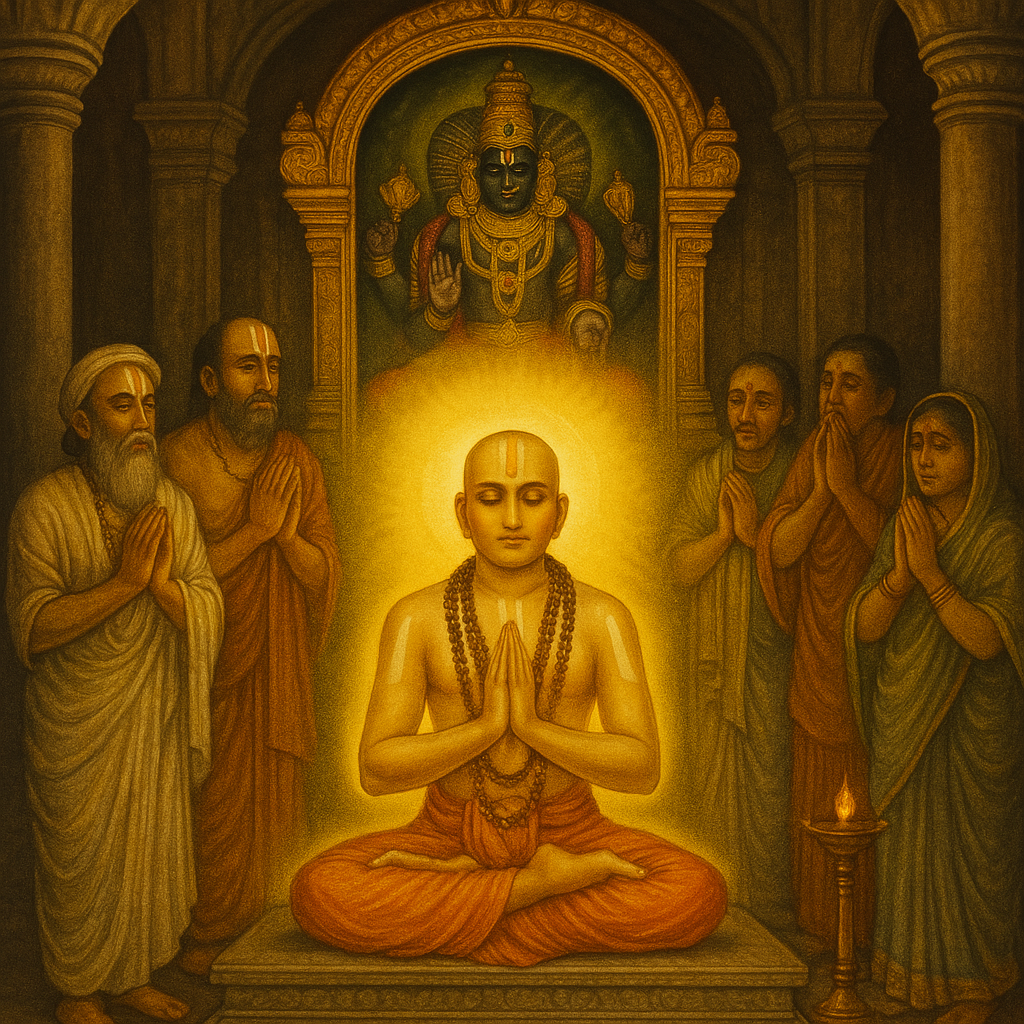
The next morning, as the devotees gathered in the temple, a divine light filled the sanctum. Slowly, the radiant form of Rāmānuja appeared before them—seated in meditation, his face serene, his hands folded in prayer, his body glowing with golden effulgence.
The devotees fell to the ground, weeping tears of joy. “Ācārya! You are here! You have returned to bless us once more!”
From within their hearts, they heard his gentle voice: “I have not gone anywhere. Wherever my devotees follow the path of surrender, there I dwell. Continue to serve the Lord and His devotees. That is where you will find me.”
From that day onward, the devotees preserved Rāmānuja’s transcendental form in Śrī Raṅgam. Unlike an ordinary statue, it radiated a living presence—the warmth of his compassion, the glow of his devotion. Pilgrims from all over India came to behold him, and many testified that his eyes appeared alive, his lips soft, as though still chanting the holy name.
To this very day, the devotees of Śrī Raṅgam bathe that sacred form with milk and sandalwood, adorn it with fresh tulasī garlands, and offer food as if he were physically present. For they know that the saint who lives for the Lord never dies. His presence remains woven into the air, the chants, and the hearts of those who serve in love.
Lessons to Be Learned
- The spiritual master never departs.
The true ācārya lives eternally through his teachings and the devotion of his followers. - Faith turns remembrance into presence.
When we remember the saint with sincerity, his mercy manifests tangibly in our hearts and lives. - The body perishes, but love endures.
Rāmānuja’s living form in Śrī Raṅgam is proof that divine love transcends death and remains forever accessible.
Reflections
Śrīla Prabhupāda wrote, “The spiritual master is never absent. By sound and example, he lives forever in the hearts of his followers.” Rāmānuja’s continuing presence in Śrī Raṅgam is not a miracle of stone but of devotion. The Lord Himself preserves those who dedicate their lives to Him.
In our own lives, when we remember our spiritual teachers with gratitude and follow their instructions with sincerity, we, too, invite their living presence. The saint’s physical departure becomes not an end, but a deeper form of communion—heart to heart, soul to soul.
May the eternal form of Śrī Rāmānuja remind us that true leadership in devotion never fades. It lives forever in the echo of prayer and the rhythm of service.
Source:
The Life of Ramanujacarya by Naimisaranya Dāsa, Chapter Sixteen: “The Eternal Presence of Rāmānuja.” Bhaktivedanta Book Trust, 1986.


