As the years passed, the great ācārya Rāmānuja continued to guide thousands of devotees in the path of bhakti. His hair had turned silver, his body frail, yet his spirit glowed with undiminished strength. The temple of Śrī Raṅgam had become the beating heart of devotion, its courtyards filled with the chanting of the holy names day and night.
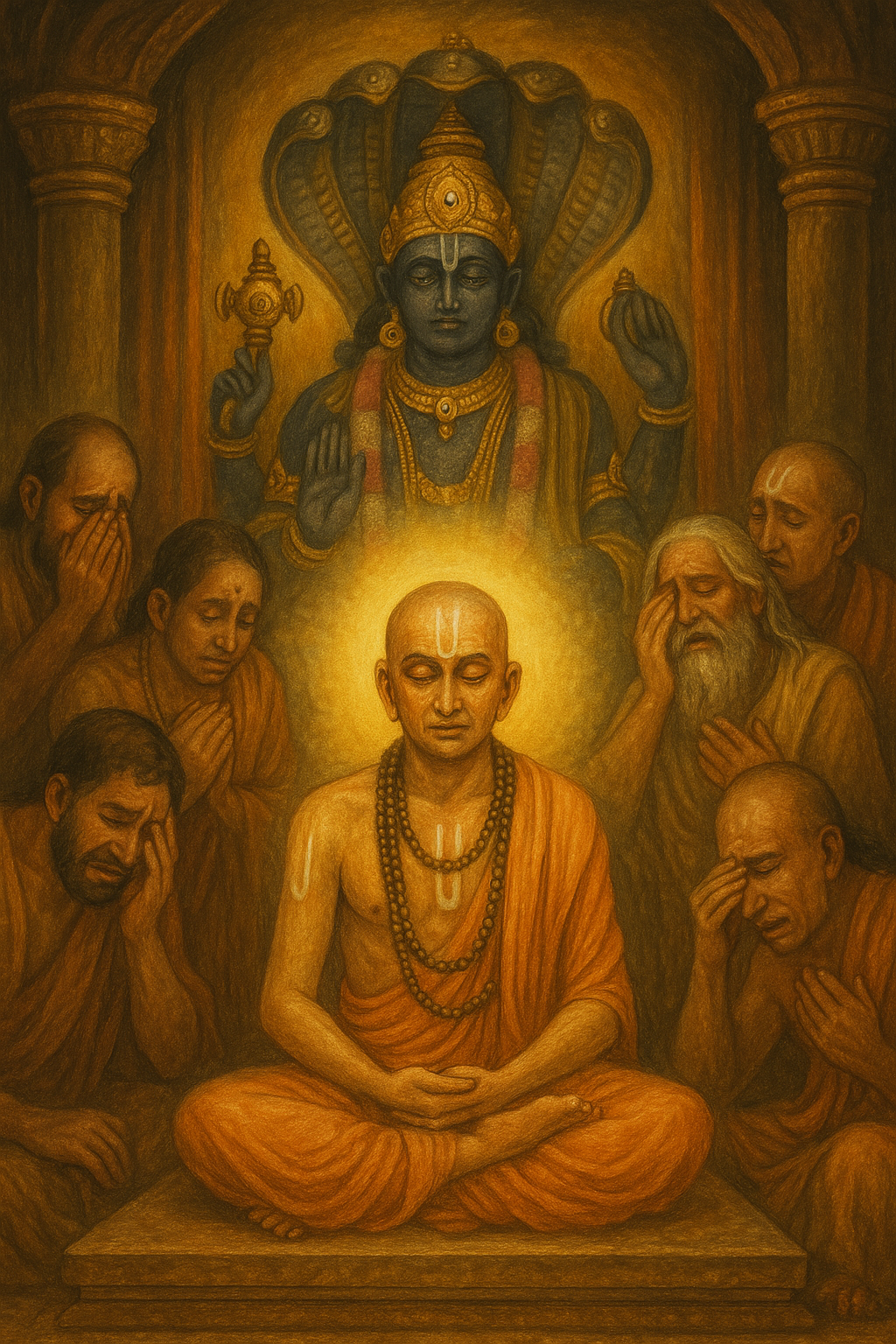
Sensing that his time on earth was drawing to an end, Rāmānuja called his disciples together. Among them were his most faithful followers—Kūrattāzhvān, Dāśarathi, and many others who had served him for decades. They sat around him, their faces filled with love and sorrow.
“Do not grieve,” Rāmānuja said softly. “The body is but a garment. The soul serves the Lord eternally. My work is complete; now it is your turn to carry the torch of bhakti to all corners of the world.”
He then gave his final instructions:
“Hold fast to humility, for pride is the enemy of love. Serve the devotees, for service is the gateway to realization. Worship Lord Nārāyaṇa, but never forget His devotees. And above all, keep your hearts soft—soft with compassion for every living being.”
As he spoke, his voice grew fainter, yet every word sank deep into their hearts like eternal jewels.
Then he turned to the Deity of Lord Ranganātha and folded his hands. “O Lord, I have given all I could—my body, my mind, my words. Let me now rest in the shade of Your lotus feet.”
A serene silence filled the room. The scent of sandalwood drifted through the air, and the golden lamps flickered gently. The ācārya sat upright in meditation, chanting softly, “Om Namo Nārāyaṇāya.” His breath slowed, his eyes half-closed in bliss, and with a final whisper of the holy name, his spirit departed to the eternal abode of the Lord.
The devotees broke into tears, yet even in their grief, they felt a strange peace, as though the Lord Himself had descended to embrace their master.
They placed Rāmānuja’s body before the Deity of Lord Ranganātha. The air resounded with the chanting of the Aṣṭākṣarī mantra that he had once given to the world. With flowers, tears, and songs, they bid farewell to their beloved teacher.
Even today, his form is preserved in Śrī Raṅgam, seated in eternal meditation—a living reminder of his boundless mercy and the light he brought into the world.
Lessons to Be Learned
- A saint’s body may perish, but his teachings live forever.
Rāmānuja’s words and example continue to guide generations, proving that spiritual life transcends time and form. - The highest service is to continue the mission.
His disciples did not mourn idly—they carried forward his message of equality, compassion, and devotion. - Departure for a devotee is reunion with the Lord.
For one who lives in the Lord’s service, death is not an end but a homecoming.
Reflections
Śrīla Prabhupāda often said, “A pure devotee never dies; he lives forever in sound.” In Rāmānuja’s final moments, we see the perfection of surrender—a life spent entirely in service ending in peace and remembrance of the Lord.
The tears of his disciples were not of despair but of gratitude. They knew that their master’s spirit had become one with the eternal flow of bhakti, guiding them invisibly.
Let this story remind us that every act of service, every chant, every offering we make in sincerity carries forward the living presence of our spiritual teachers. The saint departs, but the mission remains—and through our devotion, it lives eternally.
Source:
The Life of Ramanujacarya by Naimisaranya Dāsa, Chapter Fifteen: “The Passing of Rāmānuja.” Bhaktivedanta Book Trust, 1986.


