In the outskirts of Śrī Raṅgam lived a small group of simple villagers known as the Tirukkulathār, considered untouchables by society. Though poor and neglected, they were pure in heart and deeply devoted to Lord Ranganātha. Each day, they would stand far from the temple gates, unable to enter, singing the Lord’s names from a distance and bowing to the dust of the devotees’ feet.
One afternoon, as Rāmānuja returned from the temple after the noon ārati, he heard their melodious chanting echoing through the narrow lanes. He paused, listening attentively, his heart swelling with emotion. Turning to his disciples, he said, “Do you hear that? The voice of true devotion. The Lord accepts their song more readily than all our rituals combined.”
Determined to meet them, he walked toward the sound. His disciples hesitated, saying, “Ācārya, those people are outcastes. It is not proper for you to approach them.”
Rāmānuja stopped and replied firmly, “If they are outcastes to men, they are closest to God. I shall go to where bhakti resides.”
When the villagers saw the great saint approaching, they were frightened. “Please, revered master,” they cried, “do not come near us! We are unworthy to stand before you.”
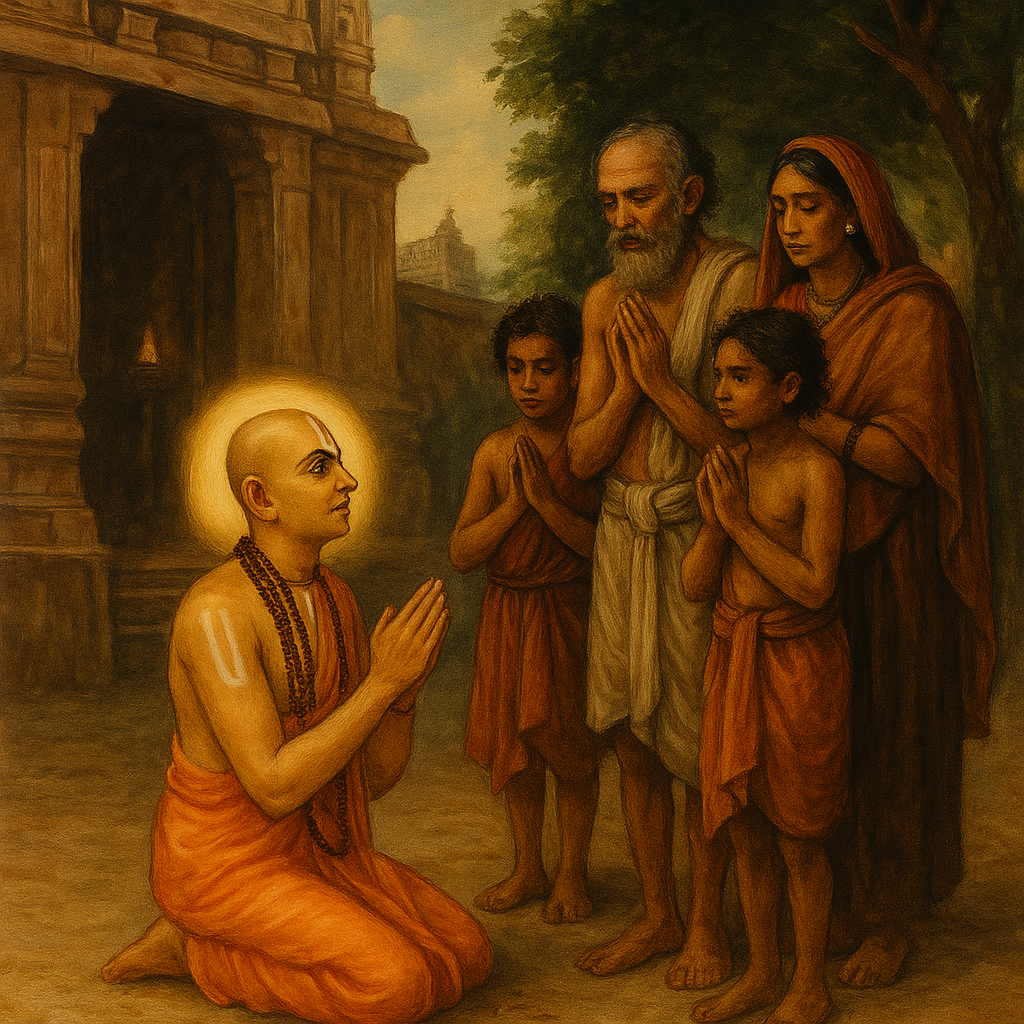
But Rāmānuja walked straight to them, folded his hands, and said, “You are the Lord’s own children. It is I who am unworthy to stand before such pure hearts.”
He then asked them to sing once more for the Lord. They began to chant the name of Ranganātha with tears streaming down their faces. As they sang, Rāmānuja himself knelt before them, placing their dust upon his head. The entire scene shimmered with divine love.
When word of this spread, some priests and scholars criticized him, saying, “Ācārya, you have broken the sacred codes of purity by touching the untouchables.”
Rāmānuja replied, “If touching the feet of devotees is impurity, then I embrace that impurity forever. The scriptures declare that the Lord dwells in the hearts of His devotees. When I bow before them, I bow before the Lord Himself.”
That act of love transformed the hearts of many in Śrī Raṅgam. The barriers of caste began to crumble, and the temple opened its outer courtyards for all to sing the Lord’s names.
From that day on, the villagers came regularly to the temple, their songs mingling with those of the priests. For Rāmānuja, this unity was the real worship—the chorus of countless hearts beating together in the love of God.
Lessons to Be Learned
- True spirituality destroys false divisions.
Rāmānuja’s compassion showed that love for God cannot be contained within social boundaries. All souls belong to the Lord. - Devotion, not birth, defines purity.
The simple songs of the so-called outcastes were more pleasing to the Lord than the elaborate chants of the proud. - A saint uplifts by humility, not authority.
Rāmānuja’s greatness lay not in commanding followers but in bowing before them, seeing the Lord in every being.
Reflections
Śrīla Prabhupāda often taught, “In the spiritual world there is no high or low, only service.” This story of Rāmānuja exemplifies that truth. His humility was not a gesture—it was realization. He saw the divine spark equally in every heart, beyond body and birth.
If we wish to honor God, we must first honor His children. The Lord is not found in exclusivity but in inclusion, not in walls but in bridges. Rāmānuja’s embrace of the outcastes was not social reform—it was divine revolution.
When we learn to see every person as a temple of the Lord, society itself becomes sanctified.
Source:
The Life of Ramanujacarya by Naimisaranya Dāsa, Chapter Ten: “The Compassion Toward the Outcaste Devotees.” Bhaktivedanta Book Trust, 1986.