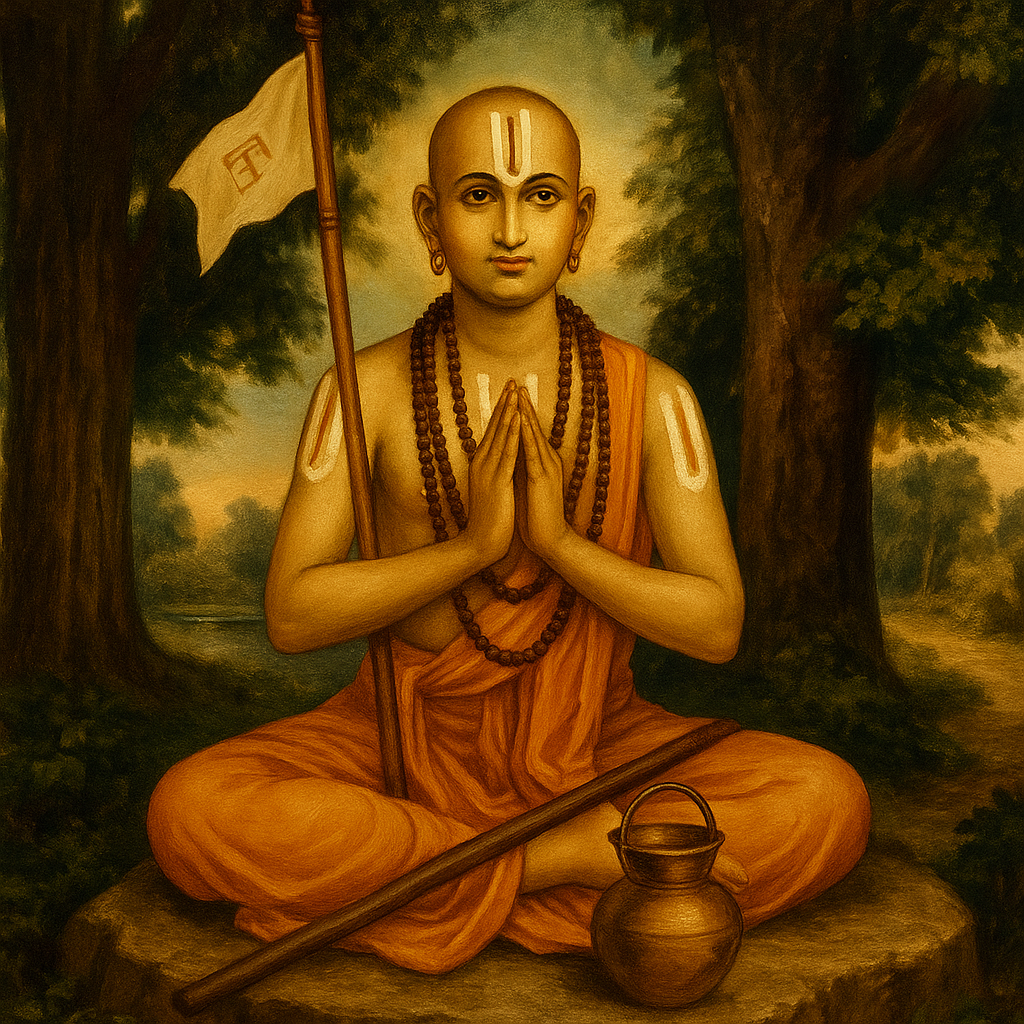
After his father’s passing, young Rāmānuja, now married to the gentle and virtuous Rakṣaka, moved with his mother Kantimati to the sacred city of Kañcīpuram. The city was known as the jewel of South India, adorned with majestic temples, towering gopurams, sacred tanks, and the soothing chants of Vedic hymns resonating through the air. Every morning, conch shells and bells echoed from the temple of Lord Varadarāja, and the fragrance of sandalwood and tulasī filled the streets.
It was here that the divine design of Rāmānuja’s life began to unfold. Having completed his early studies, he desired to deepen his understanding of the scriptures. He therefore became a student of Yādavaprakāśa, the most celebrated scholar of Advaita Vedānta in Kañcīpuram. Though Yādavaprakāśa possessed vast learning, his heart lacked humility and devotion. He taught that the Absolute Truth was impersonal, attributeless, and beyond form—a concept that would soon clash with the pure devotion stirring within Rāmānuja’s heart.
Every morning, Rāmānuja would walk through the bustling streets of Kañcīpuram to attend his teacher’s school. His path led past the temple of Varadarāja, where he would pause for a moment, fold his hands, and gaze upon the Lord’s smiling form. The sight of the Deity filled him with sweetness and peace. Often he would linger there, unable to take his eyes away.
His mother, observing this, sometimes scolded him gently. “My son, you must not be late for your studies. The Lord will be pleased when you excel in knowledge.”
But Rāmānuja would smile softly and reply, “Mother, it is from Him that all knowledge comes. How can I begin the day without seeing His face?”
Though young, he possessed a gravity and wisdom that inspired all who met him. The temple priests, seeing his daily devotion, blessed him, saying, “This boy will one day illuminate the world with the light of bhakti.”
As he entered Yādavaprakāśa’s school each day, he listened respectfully to his teacher’s lessons, but his heart often questioned the impersonal explanations he heard. When Yādavaprakāśa described the Lord as “without eyes, without hands, without qualities,” Rāmānuja would silently think, How can the one who gives sight to all have no eyes? How can He who holds the universe in His hands be without limbs?
Thus, even as he studied, the seeds of divine realization began to sprout within his heart. He understood that the true purpose of learning was not to argue or dominate others, but to awaken love for the Lord and His devotees.
Rāmānuja’s move to Kañcīpuram marked the beginning of his life’s great mission. In the holy presence of Lord Varadarāja, the young scholar’s heart began to blossom into a saintly teacher who would later spread the doctrine of loving surrender to the Supreme Lord throughout India.
Lessons to Be Learned
- Spiritual education begins with devotion.
Knowledge without remembrance of the Lord becomes dry and fruitless. True wisdom arises from devotion and humility. - The Lord arranges everything perfectly for His devotee.
Even the choice of a teacher and the city of residence were parts of Rāmānuja’s divine preparation. The Lord placed him in Kañcīpuram, where his spiritual awakening would begin. - Questioning with faith leads to realization.
Rāmānuja’s inner doubts were not rebellion but genuine inquiry, born from love for truth. Such questioning purifies the heart.
Reflections
Moving to Kañcīpuram symbolizes every soul’s journey from comfort to calling. The Lord gently pushes His devotee into new surroundings so that latent wisdom may awaken. Rāmānuja’s humility and devotion teach us how to seek truth—not with pride in learning, but with a heart open to divine grace.
Śrīla Prabhupāda taught that “real education means to know God and to love Him.” In that holy city, surrounded by the Lord’s temples and devotees, Rāmānuja began to understand that the ultimate purpose of all study is surrender—to learn not merely with the mind but with the soul.
Source:
The Life of Ramanujacarya by Naimisaranya Dāsa, Chapter Two: “Rāmānuja’s Student Life – Moving to Kañcīpuram.” Bhaktivedanta Book Trust, 1986.


