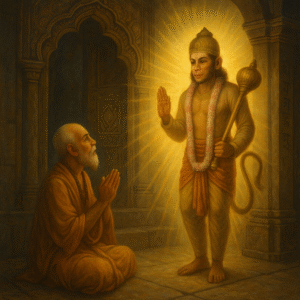
The Feast of Faith
One auspicious day in Kāśī, Tulsīdās arranged a grand feast for the brāhmaṇas. The air was filled with the fragrance of ghee, sandalwood, and the chanting of mantras. Rows of learned brāhmaṇas sat ready to partake of the sacred meal. Before them, golden plates glowed with offerings of sweet rice, butter, and milk — all prepared as an offering to Lord Rāma.
Just as the offering was about to begin, a strange figure entered the hermitage — a disheveled man, eyes filled with sorrow, and his voice trembling. “O saint,” he cried, “I am a killer of brāhmaṇas. Yet, I beg for your mercy. Grant me a morsel of your Lord’s food.”
The entire assembly fell silent in shock. The brāhmaṇas murmured angrily, “He is accursed! Such a sinner cannot enter a sacred place, let alone eat among the pure!” But Tulsīdās rose calmly, his face glowing with compassion.
Mercy Beyond Convention
“Listen, revered ones,” he said gently. “The holy name of Rāma destroys even the gravest of sins. The moment this man uttered the Lord’s name, every impurity was burned away. Should we reject one whom Rāma Himself has purified?”
The brāhmaṇas protested: “How can that be? Can the utterance of a name alone cleanse the crime of murder? You speak words beyond reason. Show us proof, O saint, that your belief is not mere sentiment!”
Tulsīdās folded his hands and smiled. “Very well,” he said. “Let us appeal to Lord Śiva Himself, the eternal witness of truth.”
The Miracle at Viśveśvara Temple
Taking a plate of sanctified food, Tulsīdās entered the temple of Viśveśvara, where stood the great bull Nandī before the liṅga of Lord Śiva. The brāhmaṇas followed, curious yet skeptical.
Standing before the deity, Tulsīdās bowed deeply and prayed:
“O Lord of Kailāsa, blue-throated one, when You drank the poison that threatened to destroy the universe, it was the holy name of Rāma that cooled and healed You. If this truth is eternal, then let Nandī accept this food as witness to the power of the Name.”
The air became still. A soft light filled the temple. Before the astonished eyes of the crowd, the great stone bull began to breathe. Slowly, Nandī lowered his head and ate the offering.
The temple resounded with gasps of awe and cries of “Victory to Rāma!” The brāhmaṇas fell flat upon the ground, tears flowing from their eyes. The miracle was undeniable — the stone had come alive by the power of the Lord’s name.
The Realization of the Learned
The head of the brāhmaṇas rose and said, “O Tulsīdās, blessed are you, saint among men! We doubted your words, but now we know — the name of Rāma alone purifies the entire universe. Truly you are Vālmīki reborn!”
All the brāhmaṇas then invited the penitent sinner to sit among them. The man, purified by devotion, wept and repeated again and again, “Rāma! Rāma! Rāma!” The entire city of Kāśī was filled with joy and chanting.
The Power of the Name
Later that evening, Tulsīdās spoke softly to his disciples:
“O children, know this truth: in the age of Kali, neither sacrifice, nor austerity, nor study of scripture can bring salvation. Only the holy name of the Lord can free the soul. When one repeats ‘Rāma,’ even unknowingly, liberation begins.”
He then quoted from the scriptures:
“When the Lord’s name enters the ear, it cleanses the heart of lifetimes of impurity, just as the rising sun drives away darkness.”
Reflections – Lessons for Devotees
- The Name Is the Greatest Power: The Lord’s name is more potent than any ritual or austerity. Through it, even a stone becomes alive, and sin becomes sanctity.
- Saints See with the Eyes of Compassion: Tulsīdās saw no sinner, only a soul yearning for grace. His heart mirrored the Lord’s mercy.
- Faith Requires Courage: To uphold truth amidst opposition requires divine conviction. Tulsīdās faced the learned brāhmaṇas without pride or fear.
- Miracles Are Signs of Love: The miracle at the temple was not a display of power but a message — that God responds instantly to the love of His devotee.
From that day forward, the city of Kāśī echoed with the chant of “Śrī Rāma Jaya Rāma Jaya Jaya Rāma.” The sinner became a saint, and the proud became humble. Thus, the holy name of Rāma triumphed once more.
Source: Bhaktavijaya, Chapter III, verses 202–243 (Mahīpati).