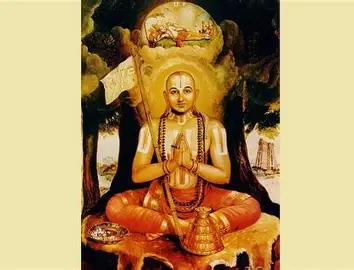
In the serene village of Śrī Perumbudur, near Kañcīpuram in South India, there lived a noble brāhmaṇa couple—Keshava Somayāji and his devoted wife, Kantimati. They were respected for their piety, learning, and compassion, yet their hearts ached for one blessing they had not yet received—a child. For many years they prayed to Lord Varadarāja of Kañcīpuram, offering flowers, ghee lamps, and heartfelt tears at His lotus feet.
One night, Kantimati had a divine dream. Lord Varadarāja appeared before her, His form glowing like molten gold. With a merciful smile, He said, “O virtuous lady, your prayers have reached Me. I shall soon appear as your son to spread the path of devotion and deliver countless souls.” Overwhelmed with joy, she awoke and told her husband the vision. They both offered obeisances, realizing that the Lord’s promise was soon to be fulfilled.
Not long after, on a sacred day in the month of Caitra (April–May), under the star of Arudra, a radiant child was born. His limbs glowed with divine effulgence, and his eyes shone with unusual brilliance. The village elders felt at once that this was no ordinary child but a divine soul descended to bless humanity. The couple named him Rāmānuja—“the younger brother of Lord Rāma.”
From infancy, Rāmānuja displayed signs of extraordinary intelligence and divine qualities. As a child, he would smile upon seeing temple processions and often fold his tiny hands when hearing the holy names of Nārāyaṇa. He would cry only when separated from the sight of the Lord’s deity.
When he reached five years of age, his father began teaching him Sanskrit, the Vedas, and the sacred rituals of the brāhmaṇas. His grasp of scripture astonished all who heard him recite. By the age of ten, Rāmānuja could quote long Vedic hymns from memory and explain their meanings with clarity far beyond his years.
Yet, despite his brilliance, his heart was filled with humility and compassion. He served his parents with utmost devotion, always attentive to their needs. When asked by his mother why he spent so much time in the temple, the young boy would answer softly, “Because there I see my true Father—Lord Varadarāja—who gives light to all souls.”
The people of Śrī Perumbudur began to speak of him with reverence. “Surely,” they said, “this child is blessed by the Lord Himself.”
As Rāmānuja grew, his desire to understand the deeper meaning of the scriptures intensified. His father, a follower of Vedic orthodoxy, sent him to the renowned teacher Yādavaprakāśa in Kañcīpuram, known throughout the land for his mastery of Advaita Vedānta. It was there that Rāmānuja’s divine mission would begin to unfold.
Lessons to Be Learned
- Divine souls appear in this world for a purpose.
Rāmānuja’s birth was not an accident but a divine arrangement to reestablish the path of loving devotion to the Supreme Lord. - Spiritual greatness begins with humility.
Even as a child prodigy, Rāmānuja remained humble, obedient, and devoted—qualities that later made him a true saint and teacher. - Parents’ devotion shapes destiny.
The faith of Keshava Somayāji and Kantimati reminds us that sincere prayer and devotion can invoke divine grace beyond imagination.
Reflections
The birth of Rāmānuja shows how the Lord sends His representatives to restore the light of bhakti whenever it begins to fade. Śrīla Prabhupāda wrote that “the Lord descends, and His pure devotees also descend, to teach by example the eternal religion of love of God.”
In this story, the love of a simple couple becomes the doorway for divine incarnation. Their faith, perseverance, and humility mirror the qualities required for any soul to attract the Lord’s mercy.
Rāmānuja’s early life teaches that true education begins not in books but in the heart purified by service and prayer. Like him, may we approach life’s mission with humility, faith, and unwavering dedication to the Lord’s will.
Source:
The Life of Ramanujacarya by Naimisaranya Dāsa, Chapter Two: “Rāmānuja’s Student Life – Early Life and Birth.” Bhaktivedanta Book Trust, 1986.


