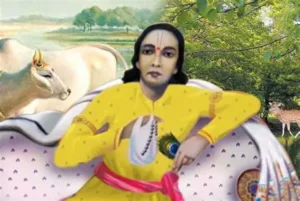
Śrī Narahari Sarkār Ṭhākura was born in the village of Śrīkhaṇḍa, about fifteen miles south of Katwa, where Śrī Caitanya Mahāprabhu accepted sannyāsa. His father’s name was Śrī Nṛsiṁhānanda, and his elder brother was Mukunda Dāsa. Both were great devotees of Kṛṣṇa, belonging to a family of physicians.
Śrīkhaṇḍa was already a center of Vaiṣṇava culture, and under the inspiration of Narahari and Mukunda, it became a radiant hub of bhakti. Later, Raghunandana Ṭhākura (the child saint) was born in their lineage, and the village became known as one of the most sacred places in Bengal.
Narahari was a brilliant scholar, poet, and composer of devotional songs. He is described in Gaura-gaṇoddeśa-dīpikā (117) as Madhumatī-sakhī, an eternal associate of Śrīmatī Rādhārāṇī in Vraja-līlā. As Madhumatī, she is known for her sweetness, her melodious voice, and her skill in decorating Śrī Rādhā and Kṛṣṇa before Their meetings. Thus, in Gaura-līlā, Narahari continued that same mood by serving Śrī Gaurāṅga through song, poetry, and ornamentation.
Association with Śrī Caitanya Mahāprabhu
When Mahāprabhu was still known as Nimāi Paṇḍita, Narahari had already heard about His extraordinary learning and divine nature. After Mahāprabhu’s transformation at Gayā, when He became immersed in ecstatic love of Kṛṣṇa, Narahari, along with Mukunda and Raghunandana, went to Navadvīpa to see Him.
The moment he beheld Gaurāṅga’s golden form, he recognized the same sweetness of Kṛṣṇa he had seen in his inner meditations. He offered prostrated obeisances, and Mahāprabhu lifted him up with tears in His eyes, saying, “Narahari, My dear friend, you have come at last! Without you, My heart was incomplete.”
From that day, Narahari became one of the Lord’s most intimate companions. Mahāprabhu loved to hear his kīrtanas, which were full of rasa and heartfelt devotion. Narahari’s voice was so sweet that it could melt even the hardest hearts.
His Service Mood toward Gaurāṅga
Narahari was unique among the devotees of Navadvīpa. Most of the Lord’s associates adored Him as Kṛṣṇa, but Narahari worshiped Him in the mood of Śrīmatī Rādhārāṇī. When Mahāprabhu manifested His mood as Rādhā, Narahari would gently decorate Him with sandal paste, flower garlands, and ornaments, just as Madhumatī-sakhī used to decorate Rādhā and Kṛṣṇa in Vṛndāvana.
The Bhakti-ratnākara describes that Narahari was so absorbed in Gaurāṅga’s beauty that he could not bear to see any other form. Once, when someone mentioned Kṛṣṇa’s name, he said softly, “I see no difference between Kṛṣṇa and Gaurāṅga. They are one, yet Gaurāṅga’s golden form is the very embodiment of mercy.”
Narahari’s Songs and Poetry
Narahari Sarkār was one of the earliest composers of Gaurāṅga-bhakti-gītā, songs glorifying Śrī Caitanya as the combined form of Rādhā and Kṛṣṇa. His most famous work is Śrī Gaurāṅga-vilāsa-smaraṇa-maṅgala-stotra, in which he meditates upon the beautiful pastimes of the Lord.
He wrote:
“I offer my obeisance unto the moon-like Lord Gaurāṅga,
whose golden complexion illumines the three worlds,
who delights the hearts of the devotees,
and whose feet are the sole shelter of all souls.”
His other compositions include Caitanya-maṅgala-stotra, Gaurāṅga-stava-kalpavṛkṣa, and Padakalpataru, filled with ecstatic love. In these songs, he revealed both the sweetness and the majesty of the Lord’s form.
Through his poetry, Narahari helped establish the worship of Mahāprabhu not only as a devotee of Kṛṣṇa but as the Supreme Personality of Godhead Himself. His verses are often quoted by later ācāryas to demonstrate Mahāprabhu’s divine identity.
Narahari and the Mercy of the Lord
Śrī Caitanya Mahāprabhu visited Śrīkhaṇḍa several times. Each time, He stayed at the home of Narahari and Mukunda. The Lord would eat only the food cooked by Mukunda’s wife and would rest in Narahari’s courtyard.
During one such visit, Mahāprabhu asked Narahari, “You are an expert in making ornaments. Please make Me an ornament that will never fade.” Narahari immediately understood the hidden meaning—He desired the ornament of pure love (prema). Folding his hands, Narahari said, “Prabhu, that ornament is already upon You, for Your heart is the ocean of love itself.”
The Lord smiled and said, “Still, Narahari, by your devotion you have decorated Me beyond all beauty.”
His Worship of Gaurāṅga as Kṛṣṇa
In his songs, Narahari often expresses his intimate vision of Gaurāṅga as Kṛṣṇa Himself. He writes:
“Some call You Caitanya, some call You Gaurāṅga,
but I see in You the same flute player of Vṛndāvana.
You have hidden the black hue of Your body
under a golden radiance for the sake of compassion.”
It is said that Narahari could never tolerate anyone seeing Mahāprabhu as a mere saint or human being. His devotion was firm and filled with intimacy—he saw Gaurāṅga not only as his Lord but also as the beloved of his heart.
Passing and Legacy
Śrī Narahari Sarkār Ṭhākura remained in Śrīkhaṇḍa even after Mahāprabhu accepted sannyāsa. Along with Mukunda and Raghunandana, he maintained the current of devotion there, converting Śrīkhaṇḍa into one of the main centers of Gauḍīya Vaiṣṇavism.
He lived long, composing many devotional songs that continued to inspire devotees for centuries. Even today, Śrīkhaṇḍa remains a holy place where the air carries the sweetness of his kīrtanas.
Reflections: Lessons from the Life of Śrī Narahari Sarkār Ṭhākura
- Seeing Divinity in the Lord’s Devotion: Narahari recognized Mahāprabhu as both the devotee and the object of devotion—the unity of Rādhā and Kṛṣṇa. His vision teaches us to see God not merely as worshiped, but as the supreme lover.
- Serving through Beauty and Art: He offered his poetry, music, and decoration as forms of seva, reminding us that artistic talent becomes sacred when used for divine glorification.
- Inner Sweetness of Bhakti: His gentle nature and songs filled with intimacy reflect that love of God is not harsh or demanding—it is tender, poetic, and filled with joy.
- Faith in Gaurāṅga’s Mercy: By recognizing Gaurāṅga’s golden form as the embodiment of compassion, Narahari taught that divine mercy is the essence of this age.
- Unity of Worship: His life shows that the goal of all devotion—whether to Rādhā-Kṛṣṇa or to Gaurāṅga—is the same: to awaken pure, selfless love in the heart.