The Twofold Attraction of Bhakti
Bhakti is a mysterious gravitational force that draws both the bhakta (devotee) and Bhagavān (the Lord) toward each other. The Lord is irresistibly drawn to the heart of His devotee, for He delights even more in the bliss flowing from pure devotion than in the bliss arising from His own divine nature.
Just as a black bee is drawn to the fragrance of a blossoming lotus, Śrī Kṛṣṇa is drawn to the fragrance of bhakti when it blooms within the heart of a devotee. This very flower of devotion blossomed in the pure heart of Bābā Jaikṛṣṇa Dāsa of Kāmyavana, compelling Kṛṣṇa to reveal Himself there.
The Saint of Kāmyavana
Bābā Jaikṛṣṇa Dāsa was a Gauḍīya Vaiṣṇava saint in the disciplic line of Śrī Gaṅgāmātā Gosvāminī of the Gaṅgāmātā Maṭha in Purī. No one knew his guru or his early life before he came to Vraja.
He lived a life of seclusion, performing sādhana beneath a tree near Vimala-kuṇḍa in Kāmyavana—a sacred forest, now partly turned into a village. People respected him as a saint of exceptional realization and humility.
At first, the local cowherd boys would often come near his hut to play, disturbing his meditation. The villagers, noticing this, built a small cottage for him, so he could engage in uninterrupted bhajana.
Bābā spent his days and nights absorbed in japa and meditation. He hardly slept, for sleeping and waking are bodily functions, and he had risen above the body. Such saints live in a higher dimension of consciousness where time, sleep, and fatigue lose their meaning.
The King’s Failed Attempt
At that time, Kāmyavana was under the rule of the king of Bharatapura, who had heard about Bābā’s spiritual greatness and desired to see him. But Bābā refused to meet worldly men, even kings.
Every evening he went to the village for madhukarī (begging alms), returning quietly to his hut. One day, while he was away, the king disguised himself as a farmer and went to sit at the door of Bābā’s cottage, hoping to meet him.
When Bābā was halfway back to his hut, he suddenly stopped, turned around, and cried aloud, “Friends! My cottage is on fire! Go quickly and put it out!”
The villagers ran to the cottage, but to their astonishment, there was no fire—only the king sitting there in disguise. Realizing Bābā’s divine insight, they respectfully told the king, “Your Majesty, please do not persist. No one, however great or powerful, can force Bābā to do anything against his will.”
The king returned to his palace humbled but deeply transformed. He realized the futility of worldly power and wealth and developed genuine humility and detachment. From that day, Bābā’s blessings began to flow upon him inwardly.
The Longing for Kṛṣṇa
For years, Bābā Jaikṛṣṇa Dāsa practiced bhajana with deep absorption, yet Kṛṣṇa had not granted him His darśana. His heart burned with Kṛṣṇa-viraha—intense separation.
One day, when his longing had reached its peak, a large group of cowherd boys gathered near Vimala-kuṇḍa, calling out at his door.
“Bābā! We are thirsty! Please give us water!” they cried.
He ignored them, thinking they were village boys disturbing his meditation. Again they shouted, “O Bengali Bābā! What kind of bhajana is this that makes you so heartless? Don’t you know it is an aparādha to turn away thirsty souls from your door?”
The Divine Encounter
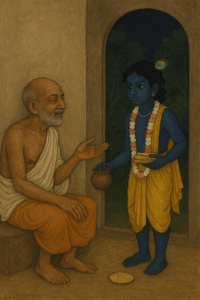
Annoyed, Bābā came out holding a stick. But as soon as he opened the door, he beheld a wondrous sight—dozens of cowherd boys, each more radiant and beautiful than the other, surrounded by graceful cows with golden bodies and jeweled horns.
Before him stood one boy whose dark-blue complexion glowed like a monsoon cloud, with a peacock feather upon His crown and a yellow garment around His waist. All anger melted from Bābā’s heart.
He asked gently, “Lad, where do you live?”
“I live in Nandagaon,” the boy replied.
“And what is your name?”
“My name is Kanhaiyā.”
Bābā turned to another boy beside Him and asked, “And what is your name?”
“My name is Baladā,” came the reply.
Kanhaiyā said, “Bābā, first give us water. Our throats are parched; we cannot speak.”
Bābā had no cups or vessels, so the boys cupped their hands, and he poured water into them from his karava (small water pot). As Kanhaiyā drank, water fell onto the ground instead of His hands, for both He and Bābā were lost, gazing into each other’s eyes, enchanted by divine love.
The other boys laughed and clapped, bringing them back to awareness, and the act of giving and receiving water was completed.
Then Kanhaiyā said, “Bābā, we come from far away and return thirsty every day. From now on, we will come to you daily. Kindly also keep some refreshments for us.”
Bābā replied, “No, no! Do not disturb me again!” and went inside, closing the door. But the sweetness of those boys lingered in his heart. Unable to resist, he opened the door again, but they were gone. The air still carried their fragrance, and the water spilled on the ground shimmered with a strange glow.
Suddenly Bābā realized—they were Kṛṣṇa and Balarāma Themselves!
The Vision of the Lord
A surge of bhāva and bhakti coursed through his body. Tears streamed from his eyes as he cried, “O my Lord! You came to me, and I turned You away!” Overwhelmed with remorse, he was ready to die of grief.
But Kṛṣṇa never abandons His devotee. When separation becomes unbearable, He appears again to console the heart that cries for Him.
Kṛṣṇa appeared before Bābā once more, smiling enchantingly. “Bābā,” He said, “I shall come to you tomorrow—and never leave again.”
Gopāla Comes to Stay
The next day, an old woman arrived carrying a small deity of Gopāla. She said, “Bābā, I am too old to serve Gopāla. I leave Him in your care.”
Bābā hesitated, “But where will I find all the things needed for His worship?”
“Do not worry,” said the old woman, “everything required for His service will come to you daily.” Saying this, she departed.
That night, the old woman appeared in Bābā’s dream as the radiant Goddess Vṛndā Devī, the presiding deity of Vṛndāvana, and blessed him.
Bābā then understood that Śrī Kṛṣṇa had fulfilled His promise. In the form of Gopāla, He had come to stay with him forever. From that day, Bābā served Gopāla with unwavering devotion until his last breath.
The Final Union
Bābā was a sādhaka of mādhurya-rasa—the mellow of divine love where the devotee regards himself as a gopī, a beloved companion of Kṛṣṇa. This became evident in his final moments.
As he prepared to leave his body, his last words were, “Where is my lahanga (skirt)? Where is my aṅgiyā (blouse)? Where is my choli (veil)?”
These were not words of delirium but of divine transformation—he was entering his siddha-deha, his eternal spiritual body in Vraja, as a gopī rushing to meet her beloved Kṛṣṇa upon hearing the sound of His flute.
Reflection
This story of Bābā Jaikṛṣṇa Dāsa reveals that the Lord is irresistibly drawn to pure love. When the devotee’s longing becomes selfless and intense, Kṛṣṇa Himself runs to fulfill it.
Bābā’s humility and simplicity became the magnet for divine grace. His example teaches that devotion is not measured by ritual or status but by the intensity of one’s yearning for the Lord.
When Kṛṣṇa delays His appearance, it is only to deepen the devotee’s love. The separation that burns like fire becomes the very light that reveals His face.
Prayer
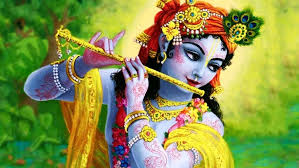
O Lord Kṛṣṇa, sweetest Cowherd of Vraja,
Draw us toward You as You were drawn to Jaikṛṣṇa Bābā.
Let our hearts become like Vimala-kuṇḍa—
Still, pure, and overflowing with love for You.
O Bābā Jaikṛṣṇa, whose eyes beheld the Divine Boys of Vraja,
Teach us to recognize Kṛṣṇa when He knocks at our door,
That we may never again send Him away.
Source: The Saints of Vraja