Śrī Sanātana Gosvāmī, one of the most intimate associates of Śrī Caitanya Mahāprabhu, lived a life of utmost simplicity in Vṛndāvana. His heart overflowed with love for Kṛṣṇa, and every step he took in the forests of Vraja was filled with remembrance of the Lord’s divine pastimes.
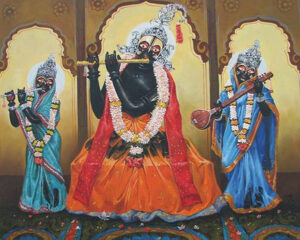
During one of his visits to Mathurā, Sanātana Gosvāmī stayed in the house of Dāmodara Caube, a devout brāhmaṇa who was worshiping a beautiful deity of Śrī Madana-Gopāla. The exquisite beauty of the Lord’s form completely captivated Sanātana’s heart. Each day, he would visit the house just to have darśana of the deity, and as he gazed upon that divine face, an irresistible longing awoke within him.
He thought within himself, “If only I could serve the Lord in this form—if only I could worship Him day and night! But I am a wandering beggar with nothing. How could I ever perform His worship properly?”
As days passed, his longing grew deeper. Then one morning, the lady of the house approached him with folded hands, tears streaming down her face.
“Bābājī,” she said softly, “last night Madana-Gopāla appeared in my dream. He said, ‘Give Me to Sanātana Gosvāmī. I desire to be with him. He longs to serve Me, and I wish to accept his service.’”
Her voice trembled as she continued, “I am old and my hands are weak. I cannot serve Him properly anymore. Please accept Him, Bābājī. It will fulfill His wish and mine as well.”
Sanātana Gosvāmī bowed down with reverence and humility. “How can I, a penniless renunciant, take charge of such a precious Lord?” he asked. But the woman’s faith was unshakable. Understanding that this was indeed the Lord’s own desire, he accepted the deity with tears in his eyes and brought Him to his humble hut by the Yamunā.
He installed the deity there and began to serve Him with the purest devotion, though his offerings were simple. Every day he prepared small balls of barley flour mixed with water—bāṭī—without salt, ghee, or any spices. With great love, he placed them before the deity, singing softly the names of the Lord.
For several days, Śrī Madana-Gopāla accepted this austere fare without complaint. But one night, He appeared to Sanātana in a dream, smiling playfully, and said:
“Sanātana, these dry flour balls are hard to swallow. Could you not add a little salt?”
Sanātana awoke and began to weep, feeling both astonished and amused by the Lord’s affectionate demand. Bowing down before the deity, he said with deep humility, “My beloved Lord, I am a beggar. If I begin adding salt today, tomorrow You may desire ghee, then sweets—and I will not be able to fulfill Your wishes. Please continue to accept whatever I can offer with love.”
From that day onward, Śrī Madana-Gopāla never again made any request. His gentle smile remained upon His face, as if delighting in the simplicity of His servant’s heart.
It is said that the Lord was so pleased with Sanātana’s selfless devotion that He later guided him to discover many of the sacred sites of Vraja’s lost pastimes.
The same deity of Madana-Gopāla, later known as Śrī Madan-Mohan, is worshiped today in the famous temple on the bank of the Yamunā in Vṛndāvana, a living testimony to this sacred exchange of love between God and His devotee.
Reflection
The Lord accepts not what is offered by the hand, but what is offered by the heart.
A dry piece of bread presented with love is sweeter to Him than all the delicacies of the world.
This story shows the depth of divine intimacy between the Lord and His devotee. The playful conversation between Sanātana and Madana-Gopāla reveals that bhakti is not formal worship—it is a living relationship. The Lord who governs the universe can become a simple child, craving salt from the hands of His loving servant.