The Age of Inquiry and the Rise of Śaṅkarācārya
Ours is an age filled with questions about existence, purpose, and the mysteries of life. Yet these questions are not new. Long before our modern search for truth, great civilizations also sought to understand what lies beyond birth and death. One such golden era dawned in India during the eighth century A.D. with the appearance of Śrī Śaṅkarācārya, the incarnation of Lord Śiva, who brought forth a brilliant philosophical movement known as Advaita Vedānta, the doctrine of nondualism.
Restoring the Authority of the Vedas
At that time, the authority of the Vedic scriptures had been greatly diminished by the influence of Buddhist philosophy, which taught a doctrine of emptiness (śūnyavāda) and negation (nirvāṇa). Guided by emperors such as Aśoka, Buddhism had spread across the entire subcontinent. Śaṅkarācārya, endowed with vast learning and divine intelligence, traveled across India, reestablishing the dignity of the Upaniṣads, the Vedānta-sūtras, and the eternal Vedic truths.
Through his debates, he systematically defeated all opposing schools of thought and revived the concept of Brahman, the eternal spiritual reality, as the foundation of all existence.
The Compromise Between Theism and Atheism
Śaṅkarācārya’s doctrine can be summarized in a single line:
“Brahma satyam jagan mithyā” — Brahman is real, the material world is false.
He taught that the Supreme Spirit alone exists eternally and that material existence is illusory. To gradually elevate society back toward theism, Śaṅkarācārya preached a philosophical compromise—not complete atheism like the Buddhists, nor full-fledged personal theism, but a bridge between the two.
The Hidden Purpose Revealed in the Padma Purāṇa
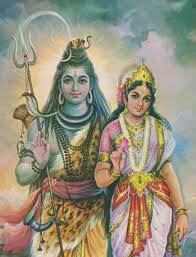
In the Padma Purāṇa (Uttara-khaṇḍa 25.7), Lord Śiva reveals to Pārvatī his divine mission:
mayāvādam asac-chāstraṁ
pracchannaṁ bauddham ucyate
mayāiva vihitaṁ devi
kalau brāhmaṇa-mūrtinā
“O Devī, in Kali-yuga, I shall appear in the form of a brāhmaṇa to teach a disguised form of Buddhism known as Māyāvāda.”
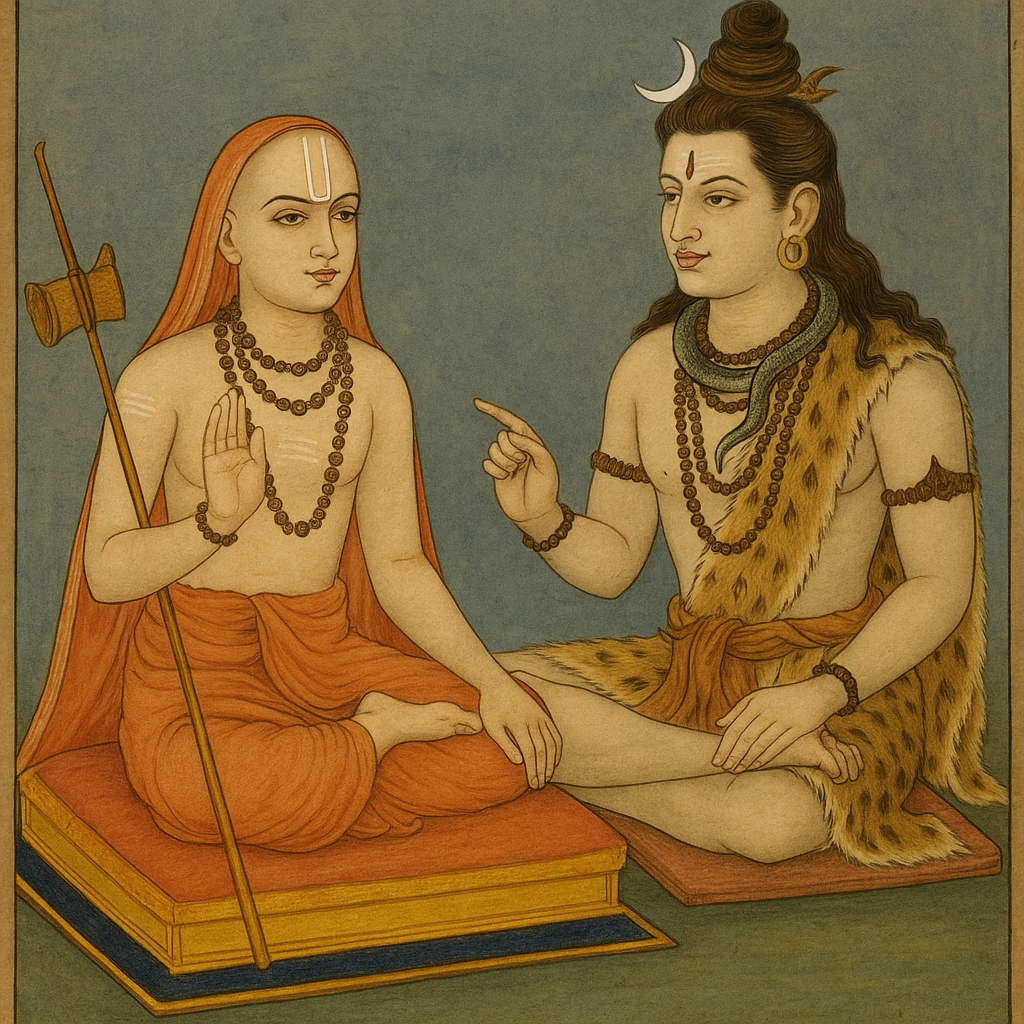
Thus, Śaṅkarācārya is recognized as an incarnation of Lord Śiva, appearing by the will of the Supreme Lord to mislead the atheists toward partial truth and then gradually redirect them toward devotion.
Early Life and Divine Mission
Śaṅkarācārya was born in Kaladi, Kerala, to the pious brāhmaṇa Śivaguru and his wife Āryā. From childhood, he displayed extraordinary memory and wisdom. His father passed away when he was only three, and his mother raised him alone.
At eight years old, Śaṅkara desired to renounce worldly life, but his mother refused. One day, while bathing in a river, a crocodile caught his leg. In desperation, he asked his mother’s permission to take sannyāsa (renunciation), saying that only by doing so could he be saved. She consented, and miraculously, the crocodile released him.
Having received his mother’s blessing, the boy set out as a wandering monk.
Meeting His Guru – Govindapāda
While traveling, Śaṅkara met the great sage Govindapāda, disciple of Gauḍapāda, who in turn was the disciple of Śukadeva Gosvāmī, son of Vyāsadeva. Recognizing Śaṅkara’s divine nature, Govindapāda initiated him into transcendental knowledge and taught him the four great truths:
- prajñānam brahma – Consciousness is Brahman.
- ayam ātmā brahma – The self is Brahman.
- tat tvam asi – You are that Brahman.
- ahaṁ brahmāsmi – I am Brahman.
Govindapāda instructed Śaṅkara to go to Kāśī (Benares) and reawaken Vedic understanding among scholars and seekers.
Conquering India Through Knowledge
At only twelve years old, Śaṅkara began teaching in Kāśī. His profound intellect and spiritual realization astonished even the most learned scholars. He wrote brilliant commentaries on the Brahma-sūtras, Bhagavad-gītā, and the Upaniṣads, explaining that Brahman—the impersonal, unchanging spiritual reality—was the essence of everything.
His Śārīraka-bhāṣya on the Brahma-sūtras became the cornerstone of Advaita Vedānta. His emphasis on renunciation and detachment inspired generations of seekers to abandon material desires.
The Famous Debate with Maṇḍana Miśra
Śaṅkara’s most famous debate was with the scholar Maṇḍana Miśra in southern India, moderated by Maṇḍana’s learned wife Bharatī. The debate lasted eighteen days. When Maṇḍana’s flower garland withered while Śaṅkara’s remained fresh, victory was declared.
Bharatī, however, challenged Śaṅkara further, questioning his understanding of love and human relationships. Being a celibate monk, Śaṅkara entered, through mystic yoga, the body of a king named Amaruka to experience worldly life and returned with perfect understanding. Impressed, Bharatī also accepted defeat.
Maṇḍana Miśra became his disciple, known thereafter as Sureśvarācārya.
His Establishment of Four Monasteries
To preserve Vedic knowledge, Śaṅkarācārya established four maṭhas (monasteries) in the four directions of India:
- Badrinātha in the North,
- Jagannātha Purī in the East,
- Dvārakā in the West, and
- Śṛṅgerī in the South.
These institutions still uphold his teachings today.
Final Years and Departure
For sixteen years, Śaṅkarācārya ceaselessly preached Advaita Vedānta, guiding people from gross materialism to spiritual inquiry. At the age of thirty-two, while traveling in the Himalayas, he entered the eternal abode of the Lord.
Though known for his nondualistic philosophy, Śaṅkara also composed deeply devotional hymns like the Bhaja Govindam, revealing his hidden heart as a pure devotee of the Lord.
The Final Teaching – Bhaja Govindam
bhaja govindam, bhaja govindam
bhaja govindam, mūḍha-mate
samprāpte sannihite kāle
na hi na hi rakṣati ḍukṛñ-karaṇe
“Worship Govinda, worship Govinda, worship Govinda, O foolish mind! Your grammatical rules and word jugglery will not save you at the time of death.”
In his final instruction, Śaṅkarācārya urged all to abandon dry intellectualism and take refuge in Govinda, the Supreme Lord.
Reflections
Śaṅkarācārya’s life reveals how divine missions are shaped by time, place, and circumstance. As an incarnation of Lord Śiva, he played a crucial role in transitioning India from nihilistic atheism to the threshold of spiritual theism. His intellectual brilliance, discipline, and selfless purpose demonstrate that even apparent contradictions in divine missions serve the Lord’s plan to uplift humanity.
Despite preaching impersonalism, Śaṅkara’s personal devotion to Govinda shines through his final words—showing that the ultimate truth, beyond all reasoning, is love and surrender to God.
Lessons to Be Learned
- Every Age Has Its Messenger: The Lord sends His representatives—like Śaṅkarācārya—to restore balance in spiritual understanding.
- Adaptation for Elevation: Sometimes truth is revealed gradually; Śaṅkarācārya taught in a way that the people of his time could accept.
- Knowledge Must Lead to Devotion: Intellectualism without devotion cannot liberate the soul. True wisdom culminates in love for Govinda.
- Renunciation Brings Real Joy: Śaṅkara’s detachment shows that real happiness lies not in possessions, but in inner realization.
- Even the Greatest Teachers Are Servants of God: Though Lord Śiva appeared as Śaṅkarācārya to preach nondualism, his ultimate instruction was Bhaja Govindam—to worship the Supreme Personality of Godhead.