The Depth of Rādhā’s Love
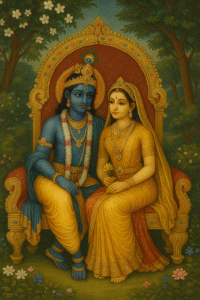
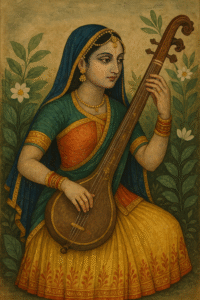
After Kṛṣṇa left Vṛndāvana for Mathurā, the gopīs continued to live, but only outwardly. Their bodies moved, but their hearts had gone with Him. Among them, Śrīmatī Rādhārāṇī’s pain was beyond description. The very air of Vraja, once fragrant with Kṛṣṇa’s presence, now felt heavy and empty.
Every sight reminded Her of Him—the flute in the distance, the call of the cuckoo, the peacock feathers glistening in the forest. The breeze that once carried His scent now only deepened Her longing. In separation, She saw Kṛṣṇa everywhere and yet could not touch Him.
The scriptures describe that Rādhārāṇī’s love in separation (vipralambha-bhāva) is the highest form of devotion. Her love burns like fire, yet nourishes like nectar. It purifies the entire universe.
Rādhā Speaks to a Bumblebee
One day, sitting on the bank of the Yamunā with Her sakhīs, Rādhārāṇī saw a black bumblebee buzzing around Her feet. Mistaking it for a messenger of Kṛṣṇa—since its color resembled His dark complexion—She began to speak to it.
“O bumblebee,” She said, “you come from Mathurā, do you not? You must be a friend of that deceiver who left us without a word. Why do you hover near Me now? Have you come to bring another false message?”
Her sakhīs watched silently as Rādhā’s words flowed like a river—half anger, half love, full of divine madness. “Tell your master,” She continued, “that we do not resent Him. We only wish He would remember us once, as we remember Him each moment. The fragrance of His body, the sound of His flute—these haunt us day and night. We do not seek jewels or palaces, only the dust of His lotus feet.”
As She spoke, tears streamed down Her cheeks. The bumblebee circled around Her face and landed on a flower near Her hand. Thinking it had gone away, Rādhā sighed, “Ah, it has left. Just like Kṛṣṇa.”
But when the bee returned, She smiled faintly through Her tears. “Even you cannot stay away long, little one. How could Kṛṣṇa forget Me forever? He may leave My sight, but not My heart.”
The Sakhīs Console Rādhā
Seeing Rādhārāṇī’s state, Lalitā and Viśākhā tried to comfort Her. “Beloved friend,” said Lalitā, “Your love is eternal. Kṛṣṇa cannot remain without You for long. Even now, He must be weeping in Mathurā, thinking of Your eyes, Your laughter, Your songs.”
Rādhā shook Her head gently. “Do not console Me with such words. His duties are vast, and He belongs to all. Let Me love Him as He is—free, unattached, yet ever mine. My happiness lies in His joy.”
Hearing this, Viśākhā whispered, “O Rādhe, Your love is beyond understanding. It gives without asking, burns without consuming. You have turned suffering into devotion, and longing into union.”
The Mark of Divine Separation
The intensity of Rādhārāṇī’s separation was such that Her body bore its mark. Her limbs grew thin, Her golden complexion faded to pale ivory, and Her heart trembled like a leaf in the wind. Yet Her beauty only deepened, as though separation distilled Her love into pure nectar.
It is said that even the trees of Vṛndāvana wept at Her sorrow. The Yamunā’s waves slowed to listen to Her sighs. The clouds hovered overhead, unable to rain, as if fearing to disturb Her meditation.
This divine wound of separation, though painful, was the very source of Her greatness. For in that suffering, Her love expanded infinitely, encompassing all souls. Through Her longing, She carried the entire world closer to Kṛṣṇa.
Kṛṣṇa’s Response in Mathurā
Meanwhile, in Mathurā, Kṛṣṇa sat alone on His palace terrace. The musicians played softly, but His heart was elsewhere. Gazing at the moon, He whispered, “O moon of Vṛndāvana, tonight You must be shining on Rādhā’s face. Tell Her that I remember. Tell Her that even amidst kings and courtiers, My heart dwells with the gopīs.”
He touched His chest, feeling the wound of separation mirrored within Himself. Though They were apart by distance, Their hearts were united beyond time and space.
Reflection
This divine sorrow of Śrīmatī Rādhārāṇī reveals that separation from Kṛṣṇa is not a curse but the highest expression of love. Śrīla Prabhupāda explains that when we feel the absence of Kṛṣṇa in our lives—when our heart yearns for His presence—that very longing purifies and transforms us.
Rādhārāṇī’s wound is not despair; it is divine remembrance. Her tears are the rain that nourishes the tree of devotion. Just as She spoke to the bumblebee, pouring out Her love even in pain, we too should speak to Kṛṣṇa in every circumstance—through prayer, chanting, and heartfelt remembrance.
Let us pray:
“O Śrīmatī Rādhārāṇī, embodiment of the highest love, let a drop of Your longing enter my heart. May I never forget Kṛṣṇa, even for a moment. In joy or sorrow, in presence or absence, let my heart call His name with love as pure and deep as Yours.”