In Goloka Vṛndāvana there is a place called the Rāsa-maṇḍala. On one side of this divine arena lies a mountain known as Śataśṛṅga. This mountain later appeared on earth as Govardhana. Within Vṛndāvana are beautiful gardens filled with mālatī and mallikā flowers.
The Setting in Goloka Vṛndāvana
There, the Supreme Lord of the universe—by whose desire everything manifests—was seated on a radiant throne made of precious jewels (ratna-siṁhāsana). As He desired to relish loving pastimes, immediately from His left side appeared a most enchanting goddess, effulgent and splendid.
The Appearance of Śrīmatī Rādhārāṇī
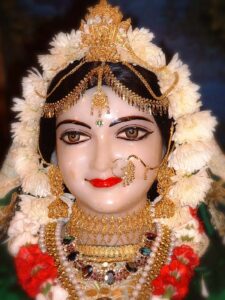
She was adorned with priceless jewels and draped in silken cloth purified by fire. Her form was resplendent like molten gold, illuminating all directions with Her radiance. Her face, soft and glowing like the autumn lotus, shone with a captivating smile revealing pearl-like teeth. Around Her neck hung a garland of mālatī blossoms and a necklace of diamonds that sparkled with celestial brilliance.
Her effulgence rivaled the summer sun, and the luster of Her form outshone millions of moons. Seated beside Lord Kṛṣṇa on the jeweled throne, She was the embodiment of divine grace and beauty.
From the left side of Śrī Kṛṣṇa’s transcendental body, Śrīmatī Rādhārāṇī thus appeared. When the Lord gazed upon Her, He desired to relish loving pastimes with Her. Understanding His wish, Her beauty increased infinitely, and She immediately ran to gather flowers to offer at His lotus feet.
The Meaning of Her Name “Rādhā”
Because She appeared within the Rāsa-maṇḍala and ran swiftly to serve the Lord by collecting flowers, She became known as Rādhā. The syllable “rā” represents the rāsa-maṇḍala, and “dhā” comes from dhāvamānā, meaning “She who runs.”
Thus, since She appeared in the Rāsa-maṇḍala and ran (dhāvamānā) toward the Lord—seeing Him eager for pastimes (ramaṇa)—Her name became Rādhā.
The Revelation from Nārada-Pañcarātra
Regarding the appearance of these two forms from the one original Supreme Lord, it is stated in the Nārada-pañcarātra (2.3.21):
dvibhujaḥ so ’pi goloke
babhrāma rāsa-maṇḍale
gopa-veśaś ca taruṇo
jaladaḥ śyāmasundaraḥ
eka īśaḥ prathamato
dvidhā-rūpo babhūva saḥ
ekā strī viṣṇu-māyayā
pumān ekaḥ svayaṁ vibhuḥ
sā ca svecchāmayaḥ śyāmaḥ
saguṇo nirguṇaḥ svayam
tāṁ dṛṣṭvā sundarīṁ lolāṁ
ratiṁ kartuṁ samudyataḥ
“The two-handed Supreme Lord, Śyāmasundara, whose bodily hue is like a fresh raincloud, wandered in the Rāsa-maṇḍala of Goloka Vṛndāvana in the dress of a youthful cowherd boy. The one Supreme Lord divided Himself into two forms: one as the beautiful female, His internal potency—Viṣṇu-māyā—and the other as Himself, the Supreme Male, all-powerful and self-sufficient. Seeing that most beautiful form, He became eager to relish loving pastimes with Her.”
The Oneness and Difference of Rādhā and Kṛṣṇa
There is no distinction between Rādhā and Kṛṣṇa. Kṛṣṇa serves Rādhā, and Rādhā serves Kṛṣṇa. Kṛṣṇa is the energetic source, and Rādhā is His energy.
As the Caitanya-caritāmṛta declares:
rādhā—pūrṇa-śakti, kṛṣṇa—pūrṇa-śaktimān
dui vastu bheda nāi, śāstra-paramāṇa
“Rādhā is the full power, and Kṛṣṇa is the possessor of full power. The two are not different—this is confirmed by revealed scripture.”
Thus, it is explained that Rādhā and Kṛṣṇa are one in essence. Rādhā is the energy (śakti), and Kṛṣṇa is the energetic (śaktimān), just as heat is the natural energy of fire. One cannot separate heat from fire; similarly, one cannot separate Rādhā from Kṛṣṇa. Together, They are one indivisible reality, the complete Absolute Truth—Śrī Śrī Rādhā-Kṛṣṇa.
The Desire of the Supreme
Parabrahman Kṛṣṇa is rasa-svarūpa—the very embodiment of divine love and bliss—and He desires to relish that rasa. The Śruti declares, sa kāmayate—He desired.
But the Śruti also says, ekākī sa na ramate—He cannot enjoy alone. To relish the sweetness of love, there must be two. Therefore, although He is one, since time immemorial He has manifested in many forms for the purpose of loving exchange.
Rādhā and Kṛṣṇa are originally one. Though eternally united in essence, They have manifested in two forms—lover and beloved—for the sole purpose of tasting the sweetness of divine love.
Reflection
This divine appearance of Śrīmatī Rādhārāṇī reveals the eternal secret of love: the Absolute Truth is not barren or impersonal but full of loving exchange. Kṛṣṇa desired to taste His own bliss, and thus Rādhārāṇī appeared as the embodiment of His pleasure potency.
In our spiritual life, we can learn that real love means service. Just as Rādhā runs to serve Kṛṣṇa, the soul finds fulfillment only when running toward the service of the Divine. The oneness of Rādhā and Kṛṣṇa teaches that the servant and the served are eternally united through love.
Śrīla Prabhupāda often reminded us that to approach Kṛṣṇa, we must seek the mercy of Śrīmatī Rādhārāṇī. Only through Her compassion can the heart be awakened to pure devotion. She is the doorway to divine love, the golden bridge between the conditioned soul and the all-attractive Lord.
Let us therefore pray that the name and form of Śrī Rādhā may eternally dwell within our hearts, guiding us to serve Kṛṣṇa selflessly and joyfully, in the spirit of Her perfect devotion.