The Sweet Anger of Divine Love
Among the countless pastimes of Śrīmatī Rādhārāṇī and Lord Kṛṣṇa, the most enchanting are those in which They quarrel and reconcile. One such pastime occurred at Dhéra-saméra, in a secluded grove known as Māna-bhañjana-sthala—the place where Rādhārāṇī’s loving anger (māna) was broken by Kṛṣṇa’s humility and affection.
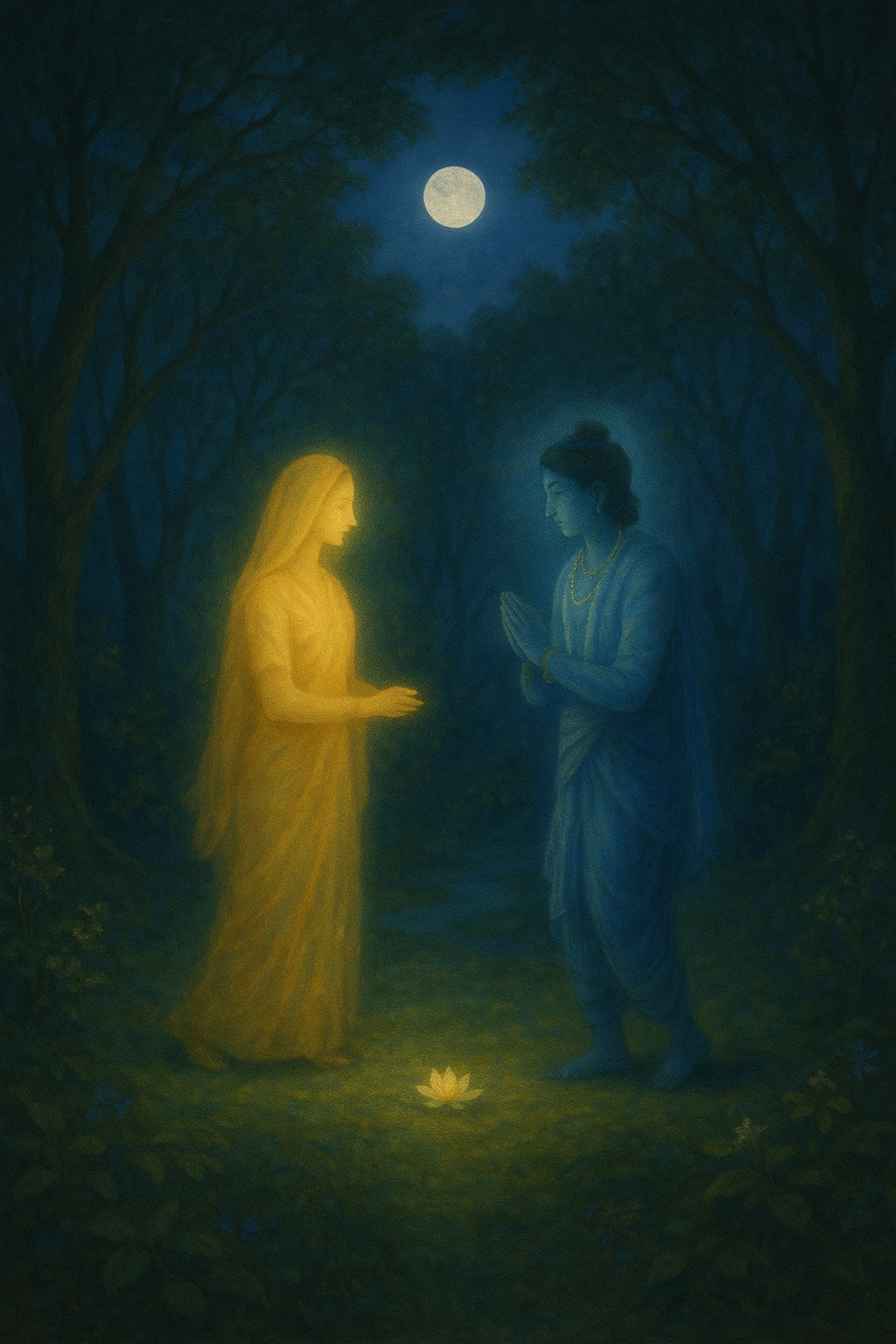
Once, during the bright full-moon night, Rādhārāṇī and Her sakhīs arrived at Dhéra-saméra for the rāsa-līlā. The forest was alive with fragrance—the kadamba trees bloomed like golden lamps, the Yamunā glimmered like a silver mirror, and the air resonated with the music of bees and nightingales. Kṛṣṇa, surrounded by the gopas, awaited Rādhā’s arrival, His flute resting upon His lips.
When Rādhā came, the entire forest seemed to light up. But that night, She carried in Her heart a trace of playful displeasure. Perhaps Kṛṣṇa had spoken too kindly to another gopī, or perhaps He had delayed in coming to Her side—whatever the reason, the Queen of Vraja had decided not to speak to Him.
The Silence of Rādhā
Kṛṣṇa approached Rādhā with a smile, eager to begin the dance of love. “O My dearest, how beautiful You are tonight! Even the moon envies Your radiance.”
But Rādhārāṇī turned away, pretending not to hear. The sakhīs giggled softly; they knew that Rādhā’s silence was sweeter than speech. Kṛṣṇa tried again, “Have I offended You, My beloved? Tell Me how I may serve You.”
Still, She remained silent. Her eyes glowed like lightning behind monsoon clouds, Her lips pressed together, and Her chin trembled slightly. Kṛṣṇa, seeing Her mood, realized that this was no ordinary anger—it was māna, the divine ornament of love.
Kṛṣṇa’s Humble Plea
Kṛṣṇa bowed His head and said softly, “O Rādhe, without Your smile, this forest loses its fragrance, the moon dims, and even My flute refuses to sing. Please forgive Me if I have been careless.”
Rādhārāṇī glanced at Him but turned Her face away again. The sakhīs, compassionate toward Kṛṣṇa, whispered among themselves, “Let us help Him; His heart is melting.”
They began to sing songs in praise of Rādhā’s beauty and Kṛṣṇa’s love. “O Rādhā,” they said playfully, “You are the very life of His soul. Without You, He forgets how to breathe!”
At last, Lalitā-sakhī, bold and clever, stepped forward and said, “My dear Rādhe, if You remain angry any longer, the world itself will stop turning. Even the stars wait for You to smile!”
The Breaking of Māna
Rādhārāṇī’s eyes softened, but She still spoke in feigned indignation, “Why should I forgive Him? He flatters all the gopīs and then comes here pretending to be sincere!”
Kṛṣṇa clasped His hands and replied gently, “O My Queen, You are My heart’s only treasure. If I have glanced at others, it was only to glorify Your beauty by contrast. There is none equal to You in all the worlds.”
Hearing these words, Rādhā’s lips curved into a faint smile. The clouds of māna began to disperse. Kṛṣṇa approached Her slowly and placed a lotus at Her feet. “If You forgive Me,” He said, “please let this flower serve as witness to Our love.”
Rādhārāṇī, unable to resist the sweetness of His humility, finally laughed. Her anger vanished like dew in sunlight. Seeing this, Kṛṣṇa joyfully placed His flute to His lips, and the rāsa dance began anew.
The Eternal Place of Reconciliation
The spot where this divine reconciliation occurred is known as Māna-bhañjana-sthala. Even today, devotees who visit Dhéra-saméra can feel the vibration of that sacred moment—the mingling of Rādhā’s tears of forgiveness and Kṛṣṇa’s joy.
It is said that the very breeze of that grove carries the fragrance of their reunion. When a devotee enters that place with a sincere heart, feelings of anger, pride, and jealousy dissolve, replaced by peace and sweetness.
Reflection
This divine pastime reveals that even disagreement in the spiritual world is an expression of love. Rādhā’s anger is not born of ego but of affection—She longs for Kṛṣṇa’s undivided attention, and Her māna deepens the intimacy between Them.
Śrīla Prabhupāda explains that love for Kṛṣṇa includes all emotions—joy, sorrow, anger, and longing—yet in the spiritual world, each is pure and nourishing to devotion. Even when Rādhā refuses to speak, Her silence glorifies Kṛṣṇa more than a thousand words.
For us, this story teaches the art of divine forgiveness. In relationships, pride and misunderstanding often cloud the heart. But when love is genuine, forgiveness restores harmony and deepens connection. Just as Rādhā’s forgiveness brought joy to Kṛṣṇa, forgiving others brings peace to our souls.
Let us pray:
“O Śrīmatī Rādhārāṇī, please remove the māna of my heart—the pride, resentment, and judgment that keep me apart from Kṛṣṇa. Teach me the sweetness of humility, the beauty of forgiveness, and the joy of surrender. May I learn to love as You love—completely, unconditionally, and eternally.”