Blessings of Bathing in Pavana Sarovara
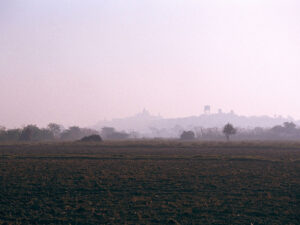
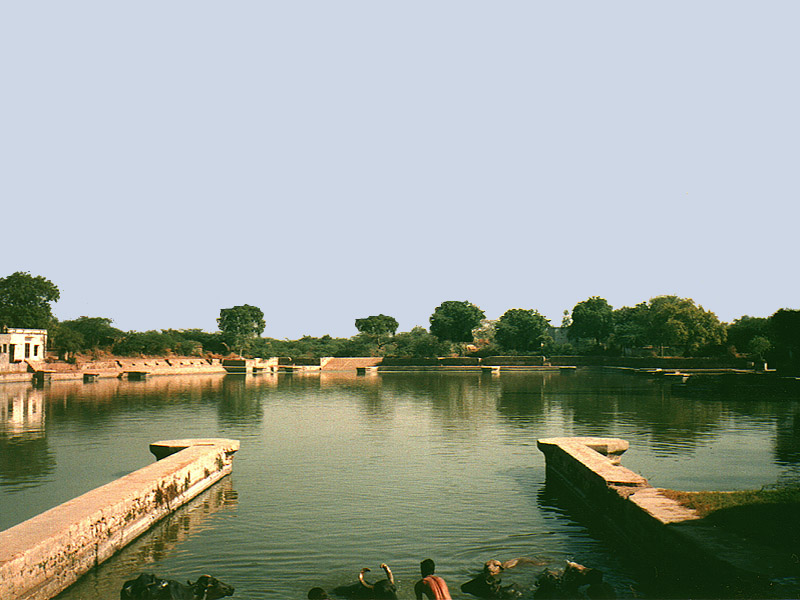
If you ever come to Nandagrāma, the first place your heart will naturally be drawn to is Pavana Sarovara. The Vrajavāsīs say, almost with a gentle smile, “Just bathe here once, and then go up to Nandīśvara Hill. When you see Kṛṣṇa, Nanda Bābā, and Mother Yaśodā together, whatever you desire will be fulfilled.”
It is not an exaggeration. This lake has witnessed centuries of devotion, laughter, longing, and divine play. One cannot stand before it without feeling that something sacred is rising from its waters — something ancient, peaceful, and deeply personal.
The scriptures lovingly describe how the gopīs would come here, pretending to fetch clear water, yet secretly hoping to meet Kṛṣṇa. And Kṛṣṇa, surrounded by the singing of bees and the shade of kadamba trees, allowed the lake to become a playground of divine affection.
Secret Groves and Gopī Pastimes
As you walk along the edges of the lake, you will find narrow paths leading into secret groves — kuñjas perfumed with lotus fragrance and alive with the hum of black bees. These groves are not ordinary; they are silent witnesses to the most intimate exchanges between the gopīs and Kṛṣṇa.
The texts say the gopīs used the simple excuse of “We must fill our water pots.” But their real hope was something far sweeter — a stolen moment with their beloved.
Nearby lies the grove known as Kāma Mahātīrtha, and not far from it a jeweled pathway called Mandara. It was in these places that Kṛṣṇa would walk, dance, and meet His devoted companions. To the north, the cows and calves grazed calmly, tended directly by the hands that hold the flute of eternity.
Śrī Rādhikā’s Watchtower Darśana
One evening, Śrīmatī Rādhikā heard that Kṛṣṇa had gone to the barn to milk the cows. Her heart stirred, and She decided to take Her “evening bath” a bit earlier. With Her intimate sakhīs, She walked gracefully to the lakeside garden and climbed a lovely wooden watchtower.
From that high place, She could see Him — Kṛṣṇa, moon-faced and brilliant, moving among the cows. Her eyes, compared by the poets to cakora birds who long to drink moonlight, were completely captured by His beauty.
Every blink was a burden.
And Kṛṣṇa? His friends whispered, gently nudging Him:
“Kanhaiyā, She is here.”
His eagerness could not be hidden. He came swiftly to the same tower, and when Their eyes met, Pavana Sarovara itself seemed to sigh in happiness.
On summer evenings, Kṛṣṇa would often cool Himself in the lake’s waters after His duties. Even now, the breeze over the water carries the softness of that memory.
Kṛṣṇa’s Summer Play and Hidden Underwater Pastimes
Sometimes, instead of going to the barn, Kṛṣṇa would tug at Mother Yaśodā’s cloth and ask, “Ma, can I go to Pavana Sarovara today? All My friends are going.”
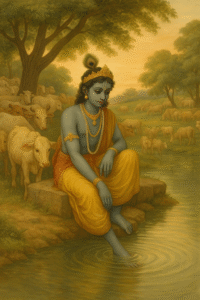
Mother Yaśodā, overflowing with love, would smile and nod. She sent servants carrying His supper, fresh clothes, and ornaments. After hours of water play, Kṛṣṇa would dress, eat, rest a little, and only then return to milk the cows with His friends.
There were also secret moments — moments that only the lake has kept.
Rādhā would enter the water on one side, Kṛṣṇa on the other.
No one knew. No one saw.
Then suddenly, silently, He would disappear beneath the surface,
swim across the soft green water,
embrace Her beneath the shimmering waves,
and return unnoticed.
Even Jaṭilā, Kuṭilā, Balarāma, and all the cowherd boys remained unaware.
Only Pavana Sarovara knew the truth and kept it gently in its depths.
Cowherd Boys’ Water Games
When the boys of Vraja came to Pavana Sarovara during the summer, the entire lake became alive with laughter. Kṛṣṇa loved playful competition — splashing, chasing, diving, and sprinkling water in joyful battle.
Shouts of “I win! I win!” echoed across the lake.
The scriptures say these games were not merely children playing —
they were expressions of divine affection, timeless and pure.
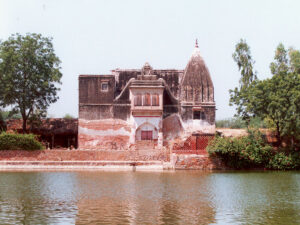
Pavana-Bihārī Temple and the Arrival of Prayāga-rāja
Once, Nanda Mahārāja planned a pilgrimage to Prayāga. Kṛṣṇa listened quietly and then said gently, “Bābā, perhaps you should go on Akṣaya-tṛtīyā.”
The next morning, when Nanda Mahārāja came to bathe in Pavana Sarovara, he saw an astonishing sight — a radiant being bathing in the lake, laughing in divine ecstasy.
“Who are you?” Nanda Mahārāja asked.
“I,” replied the figure, shining like a holy river, “am Prayāga-rāja.”
He explained that once a year, on Akṣaya-tṛtīyā, he comes to Pavana Sarovara to purify himself, for millions of people bathe in his waters and he must cleanse away their sins. That day, all the sacred rivers — Gaṅgā, Yamunā, Sarasvatī, Kaverī — appeared in feminine forms and bathed in the lake.
Nanda Mahārāja returned home astonished and told Kṛṣṇa,
“I will not go anywhere now. All holy places have come here.”
And from that day, the lake was called “Pāvana” — the purifier.
Lord Caitanya Mahāprabhu at Pavana Sarovara
Centuries later, Lord Caitanya Mahāprabhu came to Pavana Sarovara. He bathed here, absorbing the sacred atmosphere, and then climbed Nandīśvara Hill to speak to the assembled people. A small baithak — His sitting place — is still maintained near the northern bank, silently reminding us of that golden moment.
REFLECTION
When we hear about Pavana Sarovara, it becomes clear how personal and loving Kṛṣṇa’s relationship is with His devotees. Every part of this lake reminds us that Kṛṣṇa is attracted not by our material qualifications but by our genuine desire to serve Him. The gopīs came with a simple excuse of fetching water, yet their minds were fully absorbed in Kṛṣṇa. This teaches us that even ordinary duties can become spiritual when performed with remembrance of the Lord.
Kṛṣṇa meeting Rādhā secretly, playing with His friends, and personally caring for the cows shows us that Kṛṣṇa is not distant. He is a person who reciprocates personally with His devotees according to their love. Śrīla Prabhupāda often explained that Kṛṣṇa consciousness means learning to remember Kṛṣṇa in every situation — whether working, resting, or interacting with others.
Pavana Sarovara also teaches detachment from external formalities. Nanda Mahārāja wanted to travel to distant holy places, but when he realized that all sacred rivers came to Pavana Sarovara because of Kṛṣṇa’s presence, he understood the real principle: wherever Kṛṣṇa is remembered, that place becomes the true tīrtha. This is confirmed throughout Prabhupāda’s teachings — the real pilgrimage is purifying our hearts, not simply changing our location.
Finally, Lord Caitanya’s visit to this lake reminds us that we follow the same process shown by both Kṛṣṇa and His devotees: to chant, to remember, to hear about His pastimes, and to seek His shelter. Whether we live near Pavana Sarovara or thousands of miles away, the essential practice is the same — to keep Kṛṣṇa in the center of our thoughts, our daily routine, and our relationships.
By remembering these pastimes with sincerity, we become more peaceful, more humble, and more eager to serve. And that is the real purification.