The Festival of Friendship
One day, Mother Yaśodā, desiring to celebrate a festive occasion in Gokula, sent invitations to all her dear friends in neighboring villages. Among them was Queen Kīrtidā of Vṛṣabhānu’s house in Barsānā. When Kīrtidā received the invitation, she joyfully prepared to visit Gokula with her little daughter, Śrīmatī Rādhārāṇī.
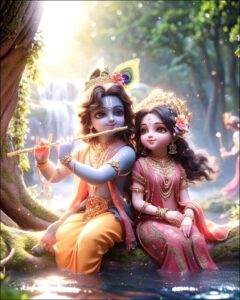
At that time, Rādhārāṇī and Kṛṣṇa were both very young—perhaps three or four years old. Even as children, Their beauty and charm captivated everyone. When Kīrtidā arrived in Gokula, Yaśodā ran out to greet her like a sister, embracing her with affection and seating her in the courtyard. “Ah, you have brought your lovely daughter! My heart rejoices to see her,” Yaśodā said.
Seeing Rādhārāṇī, Yaśodā felt a motherly attraction arise in her heart. She thought, How beautiful this girl is! How fortunate the boy will be who marries her one day.
The Auspicious Ritual
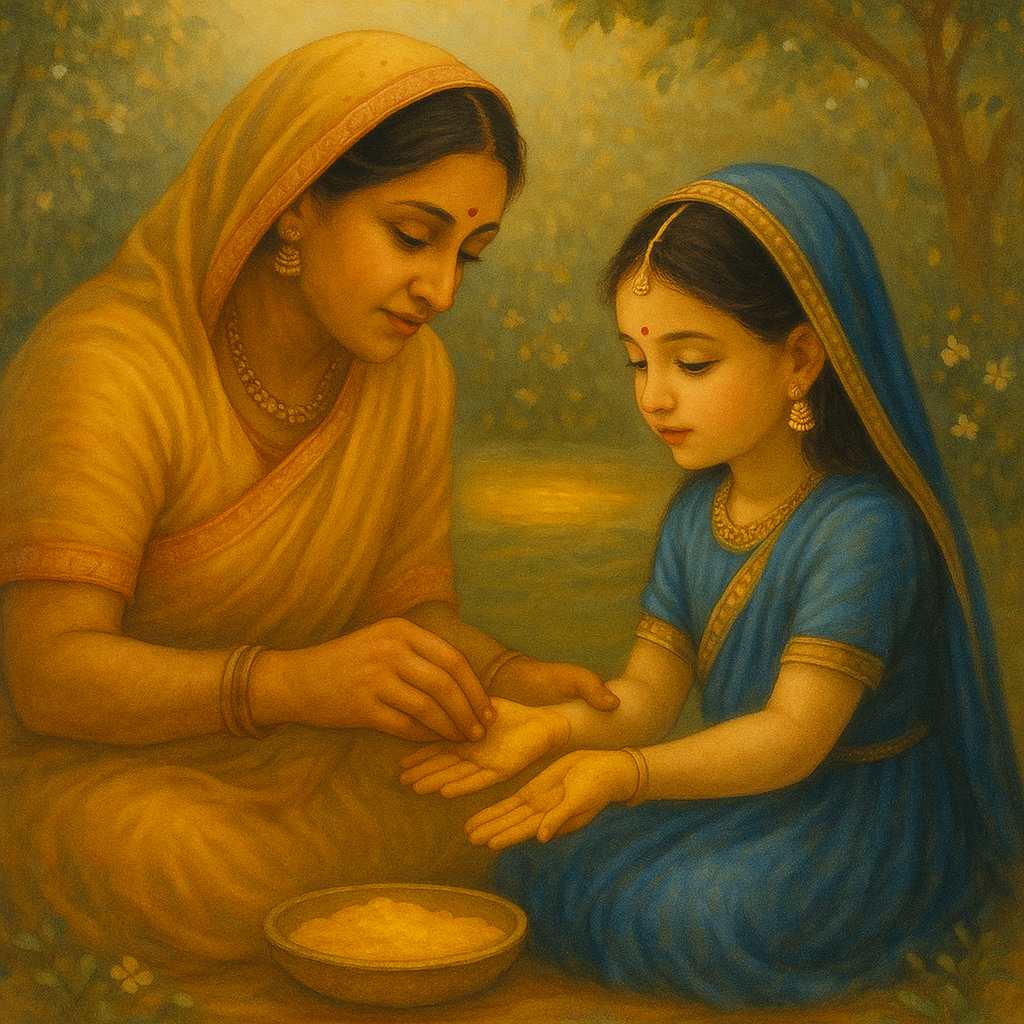
As a sign of affection and to express her goodwill, Yaśodā decided to perform a small ritual—a turmeric-smearing ceremony, considered auspicious for the future happiness of young girls. She took a small bowl of fragrant turmeric paste, mixed with sandalwood and saffron, and gently rubbed it onto Rādhārāṇī’s tender hands.
Smiling, Yaśodā said to Kīrtidā, “Your daughter will one day bring great joy to her husband’s home. She is so beautiful, so pure, so gentle—just like Lakṣmī herself!”
Kīrtidā smiled, though she didn’t realize the deep spiritual meaning behind Yaśodā’s words. The very act of applying turmeric by Yaśodā—Kṛṣṇa’s own mother—symbolized the eternal bond between Rādhā and Kṛṣṇa. It was as though the universe itself had just performed the first ritual of Their divine union.
Creation of Pīlā Pokharaṇa (the Yellow Pond)
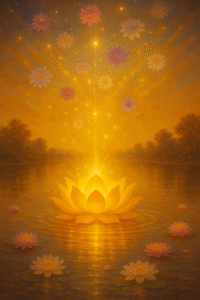
After the ceremony, Yaśodā washed her hands in a small pond nearby. As the water touched her fingers, the yellow color of the turmeric spread through the pond, transforming it into a golden hue. The waters glowed like molten sunlight, and even today that sacred place is known as Pīlā Pokharaṇa—“the yellow pond.”
The villagers who witnessed this were astonished. “What a divine sign!” they said. “Wherever these two mothers meet, auspiciousness overflows.” The children played by the pond, the gopīs sang songs of joy, and in the air there spread a feeling of peace and divine sweetness.
The Hidden Meaning
In the human world, this event seemed like a simple act of maternal affection. But in the divine reality, it was a sacred prophecy—the preparation for the eternal marriage of Rādhā and Kṛṣṇa, the union of divine love and supreme bliss. The turmeric applied by Yaśodā symbolized the blending of devotion and divinity, the merging of bhakti and bhagavān.
Thus, the pond became a witness to the eternal relationship between Rādhā and Kṛṣṇa—a love not of this world, yet mirrored in it through such tender acts.
Reflection
This gentle pastime reveals the purity and intimacy of love in Vraja. Even a simple village custom like applying turmeric becomes a divine sacrament when performed in devotion. Śrīla Prabhupāda often taught that spiritual life does not require renouncing the world but spiritualizing every act by offering it to Kṛṣṇa.
Mother Yaśodā’s affection for Rādhārāṇī is an example of vātsalya-bhakti—parental love that naturally supports the Lord’s eternal pastimes. Her simple act became a cosmic blessing, showing that every loving service offered in humility can become part of the divine plan.
The golden pond, Pīlā Pokharaṇa, reminds us that pure love leaves a trace—it colors the world around it with beauty. Just as turmeric left a golden hue in the water, so Rādhā’s devotion colors all creation with spiritual fragrance.
Let us pray:
“O Śrīmatī Rādhārāṇī, please color my heart with the golden hue of Your devotion. May my life, though simple, become fragrant with the desire to serve Kṛṣṇa. Let every touch, every act, and every thought become a sacred offering to the Divine Couple.”