Śrī Jaikrishna Dāsa Bābā, a saintly devotee belonging to the renounced order, spent the greater part of his life in Vṛndāvana, absorbed in remembrance of the Lord. He owned nothing but a small wooden bowl and a simple clay pot. His whole existence revolved around chanting the holy name of Kṛṣṇa and serving a small deity that he worshiped with great devotion.
He had renounced all material comfort and survived on alms gathered from nearby villages. What little food he received, he offered to his deity first. He spent his days chanting beneath a tree near the Yamunā, his eyes always moist with tears of love.
One year, a severe famine struck the area. Food and water became scarce, and even the most charitable villagers could give nothing. The Bābā had nothing left to eat or to offer. Yet, despite his hunger, he never ceased his daily service. Sitting before his small deity, he continued chanting softly, saying, “O Kṛṣṇa, You are my only sustenance. Whatever You give, I accept.”
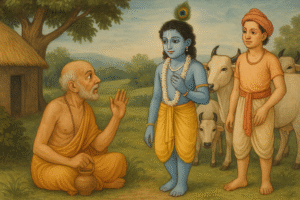
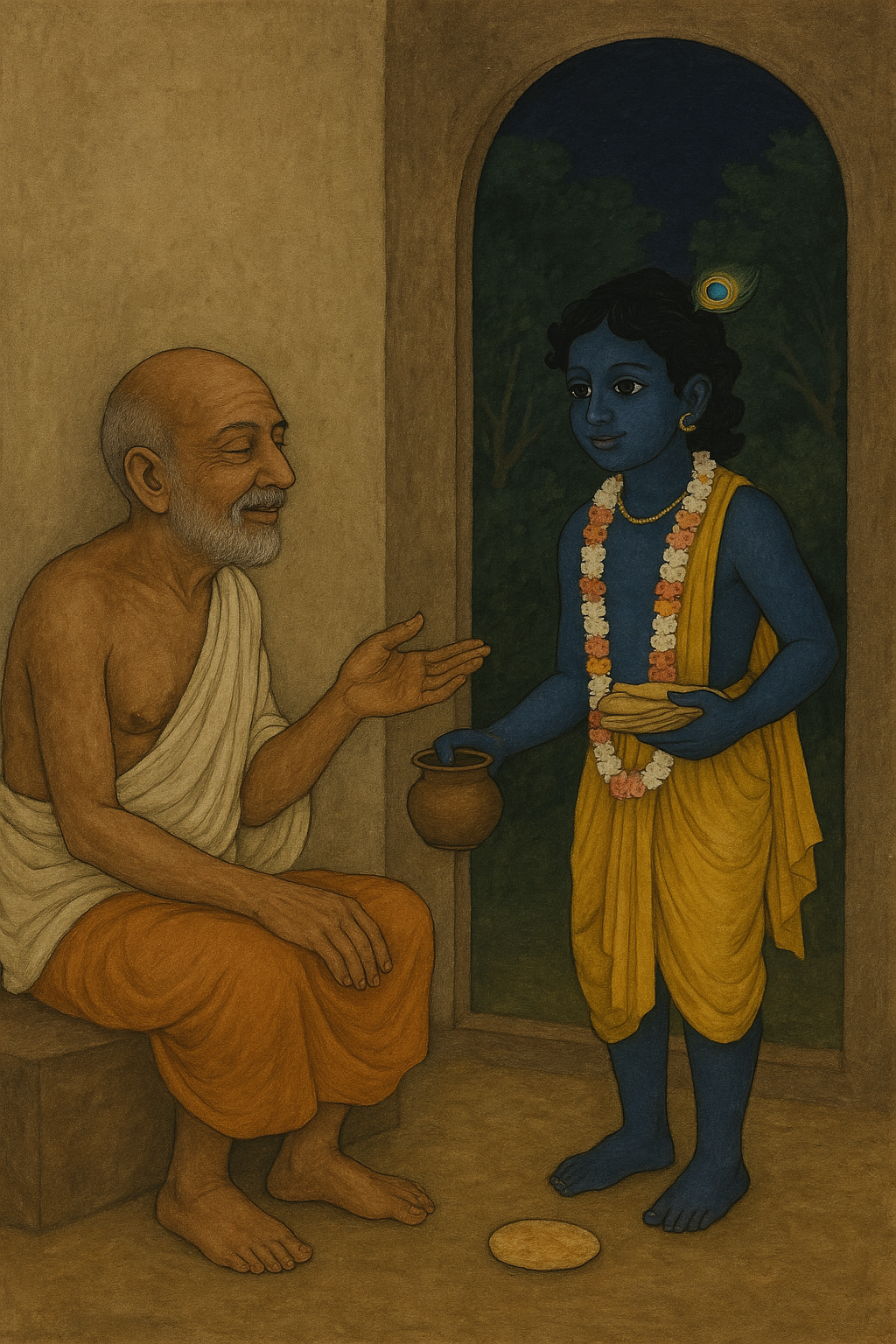
Several days passed in this way. One night, after chanting until late, he heard a gentle knock at his door. Opening it, he saw a beautiful young boy standing there—a dark-complexioned lad dressed in yellow garments, wearing a garland of forest flowers and carrying a small clay pot of milk and a bundle of flat cakes (rotis).
The boy said sweetly, “Bābā, my mother sent these for you. Please take them.”
The saint smiled, deeply moved by the boy’s kindness. “How thoughtful your mother is,” he said. “Tell her that this poor old man blesses her.” The boy placed the food before him, smiled again, and ran off into the night.
The Bābā honored the meal as prasāda, marveling at its sweetness and freshness. He had never tasted such food before.
The next morning, when he went out to inquire about the generous mother who had sent him food, no one in the village knew of any such boy or any woman who had sent provisions the night before.
Then realization dawned upon him. Falling to the ground, he cried out, “O Kṛṣṇa! You Yourself came to feed this worthless beggar! You, the Lord of all worlds, became a cowherd boy again just to serve me!”
Tears streamed down his face, and his voice choked as he wept in gratitude and love.
From that day onward, the small deity he worshiped seemed to shine with an extraordinary radiance. The Lord’s smile appeared more vivid, His eyes more alive—as if the boy who had brought the milk still lingered within that sacred form.
Śrī Jaikrishna Dāsa Bābā continued to live in Vṛndāvana until his last breath, serving and worshiping his beloved Lord with unbroken devotion, knowing for certain that Kṛṣṇa never abandons His servant.
Reflection
This story reveals that Kṛṣṇa Himself becomes the caretaker of His devotee.
When a heart depends fully on Him—without fear, without complaint, without demand—the Lord feels compelled to provide, even by taking the humblest form.
To Jaikrishna Dāsa Bābā, Kṛṣṇa was not a distant God but an intimate friend.
His poverty became wealth, because love made every morsel divine.
In that relationship, begging turns to worship, hunger becomes remembrance, and the Lord of the universe becomes a simple village boy who knocks gently on the door of His devotee.