The Devotee’s Background
Among the greatest saints of India stands Śrī Mīrā Bāī, the princess of Mewar and the divine lover of Lord Kṛṣṇa.
She was born into royal luxury but her heart longed not for power or jewels—it longed for the smiling face of Giridhāra Gopāla, the lifter of Govardhana Hill.
From her childhood, she showed signs of intense devotion. When her family arranged her marriage to Prince Bhoja Rāja of Chittor, she accepted it as destiny, but her soul remained bound only to Kṛṣṇa. She often said, “I have already given my heart to Giridhāra Gopāla—how can I belong to anyone else?”
The Divine Relationship
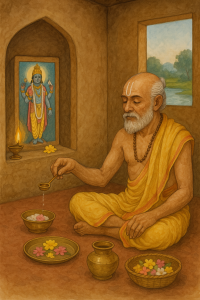
Mīrā Bāī’s days were spent in singing and worship. She would decorate her little image of Giridhāra Gopāla with flowers, jewels, and silken garments, speaking to Him as to a living person. Her voice, sweet and piercing, carried divine emotion that moved all who heard her.
Her songs, filled with longing, became her life’s breath:
“O Giridhāra! I have left kingdom, family, and honor for You.
I have made Your name my shelter—You are my only Beloved.”
But her devotion was not easily tolerated by her royal family. They accused her of bringing shame upon the dynasty by dancing in the streets with saints and singing the name of Kṛṣṇa. Her husband’s relatives tried to dissuade her, but she replied, “My Lord is the Supreme Emperor of all worlds. To serve Him is greater than ruling a thousand kingdoms.”
Trials of Devotion
The family’s anger grew, and they resolved to destroy her faith. One day they sent her a cup of poison, disguised as nectar, and told her it was prasad. Before drinking, she bowed to her Lord and said softly, “O Giridhāra, if this body of Yours can still serve You, let this drink be harmless. But if You wish me to come to You, I am ready.”
She drank it calmly—and the poison turned to nectar. The astonished attendants saw her face shining with light. She simply smiled and said, “How can death touch me when my Beloved lives in my heart?”
At another time, her enemies placed a cobra in a basket of flowers meant for her deity. When she opened it, out came a beautiful garland of fragrant blossoms. Mīrā fell to her knees and wept, “My Lord, You have again saved Your servant!”
The Lord’s Reciprocation
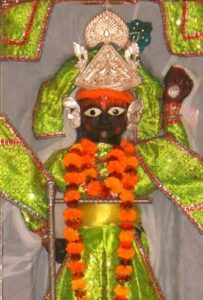
Finally, when her suffering reached its limit, she prayed before her beloved Giridhāra Gopāla in the temple of Dwārakā, crying, “O my Lord, I can no longer live separated from You. Either accept me completely or end this illusion of separation.”
That night, the temple doors opened by themselves. A radiant light filled the shrine, and the deity of Giridhāra Gopāla stepped forward, extending His hand toward her. Mīrā, overcome with ecstasy, walked into the sanctum singing her final song:
“Mīrā’s Lord is Giridhāra Gopāla—none other.
Now my union is complete.”
Before the priests could understand what had happened, she had merged into the deity. When the light faded, they found only her veil lying at the Lord’s feet. The news spread across India: the Lord of Dwārakā had taken His beloved Mīrā into Himself.
The Eternal Legacy
Her songs—simple, heartfelt, and filled with divine madness—are still sung by millions today. Through her poetry, she continues to live as the eternal voice of love that conquers death, convention, and separation.
Mīrā Bāī’s life remains a symbol of bhakti unbounded by fear or formality, showing that when love becomes absolute, even God cannot remain distant.
Reflection
Mīrā Bāī’s story teaches that true love for God is fearless.
When devotion ripens into complete surrender, the Lord Himself becomes the devotee’s protector, companion, and final destination.
She endured scorn, persecution, and threats, but her faith never faltered. The poison, the snake, the exile—all became proofs of divine care.
Love that does not break under trial becomes unbreakable. And when it becomes unbreakable, it draws God Himself into embrace.
As the Bhagavad-gītā (9.30–31) declares:
“Even if a devotee commits the most abominable acts, he is to be considered saintly, for he is rightly resolved. My devotee never perishes.”
Source
Source: “Experiences in Bhakti: The Science Celestial,” by O. B. L. Kapoor — Chapter Six: Verification of the Law of Reciprocation (place: Chittor and Dwārakā, India).