The Child’s Pain and Determination
Long ago, in the dynasty of Manu, there lived a boy named Dhruva, the son of King Uttānapāda.
Although born a prince, Dhruva suffered deeply because his father favored his stepmother’s son.
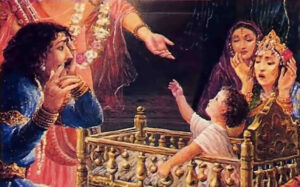
When Dhruva tried to sit on his father’s lap, his stepmother, Suruci, pulled him away harshly and said,
“My child, only the son born from my womb can sit on the king’s lap.
If you desire this honor, you must worship the Lord so that in your next life you may be born as my son.”
These cruel words pierced Dhruva’s tender heart. Trembling and humiliated, he ran to his mother, Sunīti, and wept, “Mother, tell me how I can see God. If He alone can grant me my father’s love, I will find Him.”
Sunīti, though sorrowful, spoke gently:
“Only the Lord can fulfill your desire, my son. Seek Him with all your heart. Those who meditate upon Him achieve everything.”
Hearing this, Dhruva, though only five years old, resolved firmly, “I will not return home until I have seen the Lord face to face.”
The Journey into the Forest
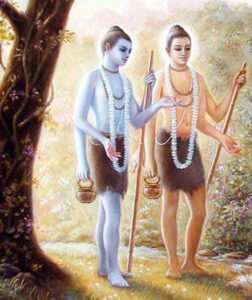
Alone, Dhruva left the palace and went into the forest. His faith drew the attention of Nārada Muni, the celestial sage and messenger of the Lord, who appeared before him and said,
“My child, you are too young for such austerities. Return home and be patient. In time, you will find happiness.”
But Dhruva replied with tears, “O revered one, I cannot wait. My heart burns with the wish to see God. Please bless me so that I may find Him.”
Nārada, pleased with the boy’s determination, gave him the mantra:
“Om Namo Bhagavate Vāsudevāya.”
He instructed Dhruva to meditate upon Lord Viṣṇu within his heart, and described His form — dark as a monsoon cloud, clothed in yellow silk, with eyes like lotus petals, holding the conch, disc, club, and lotus.
The Austerities and the Vision
Dhruva went to Madhuvana on the bank of the Yamunā and began to meditate.
Following Nārada’s instructions, he gradually reduced his food:
- For the first month, he ate fruits and berries.
- For the second, he ate leaves.
- For the third, he drank water.
- For the fourth, he subsisted only on air.
By the fifth month, his body was motionless and radiant with spiritual power.
The intensity of his devotion shook even the heavens. The demigods approached Lord Viṣṇu, saying, “O Lord, this child’s penance is shaking the universe! Please go and bless him.”
Moved by love, Lord Viṣṇu appeared before Dhruva, riding on Garuḍa, His divine eagle carrier.
Dhruva opened his eyes and saw the Supreme Lord standing before him — resplendent, smiling, and full of compassion.
Overwhelmed, the boy fell flat like a stick on the ground. When he tried to speak, his voice failed.
Seeing this, the Lord gently touched His conch to Dhruva’s forehead. Instantly, divine wisdom awakened in him, and he praised the Lord with beautiful prayers:
“O Lord, I sought a mere kingdom, but now I have received You—the jewel that fulfills all desires. I was searching for glass, but You have given me a diamond.”
The Lord’s Blessing
Lord Viṣṇu smiled and said, “O Dhruva, because of your unflinching devotion, you shall rule the earth for 36,000 years in peace and prosperity. After that, you shall come to My eternal abode and shine forever as the Dhruva star, the pole around which all planets revolve.”
Dhruva bowed and said, “My Lord, I was angry and wanted revenge, but You have purified my heart. Now I desire only to serve You.”
He returned home transformed—no longer a hurt child, but a saintly soul radiant with divine love.
Even his stepmother wept in repentance, and his father embraced him, realizing that true royalty lies in humility before God.
Reflection
The story of Dhruva Mahārāja illustrates the law of divine gravitation:
Just as all material objects are drawn toward the earth by physical gravity, all souls are drawn toward God by spiritual gravity — bhakti.
Dhruva began his quest with pride and pain, but the Lord used those emotions as the initial pull toward Himself.
Through austerity and meditation, Dhruva’s desire for revenge melted into pure devotion.
This teaches us that even material motives, when directed toward God, become purified by His attraction.
The Lord does not reject a heart that comes to Him in need — He transforms it.
As Śrīla Prabhupāda wrote,
“Dhruva wanted a kingdom greater than his father’s, but he achieved the kingdom of God instead. Such is the mercy of Kṛṣṇa — He gives what we want, and beyond that, what we truly need.”
Source
Source: “Experiences in Bhakti: The Science Celestial,” by O. B. L. Kapoor — Chapter One: Verification of the Law of Gravitation (place: Madhuvana, near Mathurā, India).