Durvāsā Muni Arrives in Vṛṣabhānu’s Village
Once, when Śrīmatī Rādhārāṇī was still a young girl living in Vṛṣabhānu’s home, the great sage Durvāsā Muni came to their village. Known throughout the three worlds for his temper as well as his spiritual power, Durvāsā wandered constantly, absorbed in meditation and austerity. Wherever he went, people received him with great respect, for his blessings and curses were both equally potent.
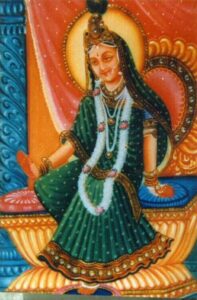
One day, as he came near the house of King Vṛṣabhānu, Rādhārāṇī saw him seated beneath a tree, thin from long fasting. Though She was just a child, Her heart overflowed with compassion. She immediately gathered fruits, milk, and sweets that Her mother Kīrtidā had prepared, and approached the sage with gentle humility.
Rādhārāṇī’s Offering
With bowed head, the golden-complexioned Rādhārāṇī offered the food and said softly, “O revered sage, please accept this simple meal prepared in devotion. It is the fortune of our family that You have come to bless our village.”
Durvāsā looked at the young girl and was deeply moved by Her pure devotion. Her eyes shone with kindness, and Her words carried the sweetness of divine love. Accepting the offering, he ate with satisfaction. Pleased by Her humility and the taste of the food, he realized that what She had offered was no ordinary meal—it was filled with spiritual energy.
Durvāsā’s Blessing
After eating, Durvāsā looked at Rādhārāṇī with affection and said, “O child, the food You have offered is more delicious than nectar itself. I feel strength, peace, and bliss within My heart. Tell Me, how did You prepare this?”
Rādhārāṇī smiled shyly and replied, “O sage, it was prepared only with devotion to the Lord. When I cook or serve, I remember Śrī Kṛṣṇa, and that remembrance makes everything sweet.”
Hearing this, Durvāsā closed his eyes and entered deep meditation. Then he said, “O blessed girl, You are no ordinary being. From this day forth, whatever You cook will be filled with spiritual nectar. Whoever eats food prepared by You will be endowed with long life, health, and happiness. Your touch will purify everything, and Your devotion will bless all beings.”
He then added, “In time to come, You will be worshipped by sages and demigods. Your name will sanctify all who hear it.”
Having spoken thus, Durvāsā Muni left, leaving behind a divine fragrance and peace that lingered in the air.
The News Reaches Mother Yaśodā
Later, the villagers spread the news of Durvāsā’s blessing. Mother Yaśodā in Gokula heard that the young daughter of Vṛṣabhānu had received this special boon. Thinking of her own son Kṛṣṇa, she became joyful and thought, “Ah, if my Kṛṣṇa could eat food cooked by that blessed girl, He would gain great strength and health.”
Thus, whenever she prepared Kṛṣṇa’s meals, she would invite Śrīmatī Rādhārāṇī to assist, and in this way, Rādhā often cooked for Kṛṣṇa. From then on, Kṛṣṇa would eat nothing unless it was touched by Her hands.
Rādhā’s Cooking as Devotion
In Vraja, it is said that Śrīmatī Rādhārāṇī’s cooking carries the flavor of Her love. Every dish She prepares reflects one of Her moods of devotion—sometimes sweet like Her affection, sometimes spicy like Her playful anger, and sometimes soft and soothing like Her compassion.
Kṛṣṇa once told Mother Yaśodā, “Mother, food cooked by Rādhā gives Me more satisfaction than nectar. It fills not only My body but also My heart.”
Thus, the sage’s blessing became fulfilled: the entire world glorified Rādhārāṇī’s service, and Her cooking became a sacred act of pure love.
Reflection
This story of Durvāsā Muni’s blessing teaches us that service performed with love and remembrance of Kṛṣṇa becomes spiritualized. Rādhārāṇī’s example reveals the essence of devotion—whatever we offer, no matter how simple, becomes divine when offered with sincerity and love.
Śrīla Prabhupāda often said that the best offering to Kṛṣṇa is not fine food, wealth, or ritual but a heart filled with devotion. When we cook, work, or serve others while remembering the Lord, our actions become bhakti-yoga—union through devotion.
Durvāsā’s blessing to Rādhā also reminds us that true purity is not external but internal. Rādhārāṇī’s holiness flowed from Her love and humility. Because She cooked not for fame or gain but to please Kṛṣṇa, Her service became the standard of perfection.
Let us therefore pray:
“O Śrīmatī Rādhārāṇī, please bless me so that whatever I do—whether speaking, cooking, or serving—may be done for Kṛṣṇa’s pleasure. Let my hands become instruments of Your service and my heart a temple of Your devotion. May every act of my life carry Your sweetness and grace.”