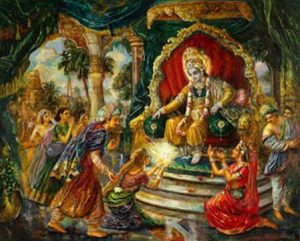
While Yamunācārya ruled as a powerful monarch, far away his grandfather Nathamuni was nearing the end of his life. Deeply saddened that his beloved grandson had become lost in worldly pleasures, Nathamuni called for his chief disciple, Rāma Miśra. “My dear Rāma Miśra,” he said, “my grandson Ālabandāra has forgotten Lord Viṣṇu, being blinded by the wealth and luxury of kingship. I can do nothing more for him. When I leave this world, you must bring him back to the path of devotion.”
After Nathamuni’s departure, Rāma Miśra carried this command in his heart for many years. At last, when Yamunācārya was thirty-five, Rāma Miśra went to the Pāṇḍya capital to meet him. But the city gates and palace courtyard were crowded with royal chariots and guards. Even powerful noblemen had to wait for hours to gain an audience. Rāma Miśra, an ascetic sannyāsī in simple robes, realized he could not reach the king by normal means.
He devised a subtle plan. Being expert in Āyurveda, he knew of a rare medicinal herb called tuduvalai that purified the mind and promoted longevity. Collecting its fresh green leaves, he went to the royal kitchen and humbly offered them to the head cook.
“O blessed one,” said Rāma Miśra, “these leaves, if served daily, will increase your king’s strength and life span. I will bring them to you every day as my offering.”
The cook, being pious, gratefully accepted. Each day for two months, the sannyāsī brought the tuduvalai leaves, and the king grew fond of the new preparation. One day, Rāma Miśra purposely did not appear. When Yamunācārya sat for his meal and found the dish missing, he asked, “Where is that wonderful spinach I enjoy so much?”
The cook replied, “My lord, the saint who brings it each day did not come.”
“A saint?” asked the king. “Who is he, and what does he ask as payment?”
“He accepts no payment,” the cook said. “He only says he serves out of love for Your Majesty.”
The king, astonished, ordered, “When he returns, show him the highest honor and bring him before me.”
The next day Rāma Miśra arrived as usual. The cook led him into the royal hall. Yamunācārya, now regal in bearing yet still with noble features, rose to greet the humble sage. “O holy one,” he said warmly, “I have heard of your kindness. You have served me daily without seeking reward. Please, tell me how I may repay you.”
Rāma Miśra smiled. “O King,” he said, “I have something very precious to deliver to you—a great treasure entrusted to me by your grandfather Nathamuni. He gave it to me before departing this world and ordered me to present it to you when the time was right.”
Yamunācārya’s eyes brightened with curiosity. “A treasure from my grandfather? Where is it?”
Rāma Miśra spoke mysteriously: “It lies within seven walls, between two rivers, guarded by a serpent. Every twelve years a southern demon comes to inspect it. Only through the power of mantra will the treasure be revealed to you.”
The king, taking this literally, immediately thought of hidden gold or jewels. “Then let us go at once,” he said eagerly. “I will take four divisions of my army for protection.”
Rāma Miśra gently replied, “There is no need for an army, O King. The treasure is divine, not material. It reveals itself only to a pure heart. Let us go alone.”
Lessons to Be Learned
- The Lord sends His messengers to awaken the sleeping soul.
Rāma Miśra’s journey shows how God never abandons His devotee, even if that devotee forgets Him amidst material luxury. - True guidance comes through compassion, not condemnation.
Instead of criticizing Yamuna’s fall, Rāma Miśra used wisdom and affection to bring him back to the spiritual path. - The real treasure is devotion, not wealth.
Material riches fade, but the wealth of remembrance of the Lord is eternal.
Reflections
Every sincere seeker has moments of forgetfulness when worldly duties overshadow devotion. Yet the Lord’s mercy works quietly through His servants—the saints, the scriptures, or an unexpected friend—who come to remind us of our spiritual inheritance. Śrīla Prabhupāda often said, “The spiritual master is the external manifestation of the Supersoul.”
Rāma Miśra represents that divine compassion. He did not preach with force but served with love until the time was ripe. In our own lives, we can learn to awaken others not by criticism but by patient example and heartfelt kindness.
Let us remember: the greatest treasure lies not buried in the earth but hidden within our own hearts—the presence of the Supreme Lord.
Source:
The Life of Ramanujacarya by Naimisaranya Dāsa, Chapter One: “Rāma Miśra’s Scheme.” Bhaktivedanta Book Trust, 1986.