THE LIVING HEART OF YĀVAT
At the center of the sacred village of Yāvat, where so many delicate and divine pastimes of Śrīmatī Rādhārāṇī and Śrī Kṛṣṇa unfolded, stands a beautiful ancient temple — the Śrī Śrī Rādhā-Rādhākānta Mandira.
Here, the sweetness of Vraja is tangible. The air is scented with sandalwood and the quiet rustling of peepal and tamāla leaves seems to echo the eternal whisper of “Rādhe Śyāma… Rādhe Śyāma…”.
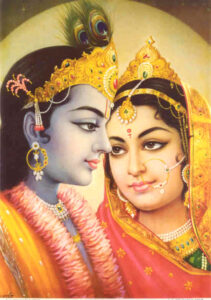
Inside the temple, on the jeweled altar, the enchanting deities of Śrī Rādhā and Rādhākānta preside — Their forms radiant, Their eyes full of mercy. The Lord stands with a gentle smile, and beside Him, Rādhārāṇī, the Queen of Vṛndāvana, glows with matchless beauty.
It is said that the aura of Their presence fills the temple with the same love that once filled Rādhā’s palace.
THE WITNESSES OF THE DIVINE PLAY
In a nearby chamber of the same temple, three figures are also honored — Jaṭilā, Kutilā, and Abhimanyu.
Though often remembered as obstacles to Rādhā and Kṛṣṇa’s meetings, they are revered in Vraja as instruments of Yogamāyā’s divine drama.
Their life purpose was to intensify the sweetness of the Divine Couple’s love. For without separation, there can be no true union; without obstacles, there can be no triumph of devotion.
Thus, the Vrajavāsīs worship them too — not as villains, but as sacred guardians of lila.
Pilgrims who visit bow before these figures with deep understanding, praying for the humility to see how even opposition in life can serve God’s will.
THE ETERNAL TREE OF LOVE
Outside the temple courtyard stands the ancient banyan tree, known in the scriptures as the Yavavata-vata. Beneath its wide, sheltering canopy, Śrī Kṛṣṇa once knelt and painted the red lac (yāva) on Rādhārāṇī’s lotus feet, creating the original beauty of Yāvat’s name.
Later, this same tree became His hiding place — when, disguised as a cuckoo bird, He sang through the moonlit night to catch Rādhā’s attention.
That banyan still stands today, its roots twisting deep into the earth of Vraja, its leaves whispering tales of divine mischief and transcendental affection.
The devotees who visit it do not see just wood and leaves; they see a living witness of Kṛṣṇa’s love — a tree that has seen eternity, a tree that has heard Rādhā’s laughter and felt Kṛṣṇa’s tears.
When pilgrims come to bow at its roots, they often weep. For beneath its shade, the veil between the spiritual and the material world feels thin — as if the very dust still remembers the touch of Their lotus feet.
REFLECTIONS
The temple of Rādhā-Rādhākānta and the ancient banyan tree together reveal a truth hidden in plain sight:
that the pastimes of Vṛndāvana never end.
Though the Lord’s visible play may have withdrawn, its fragrance remains in the air, its rhythm in the dust, its sweetness in the heart of anyone who bows there with love.
To stand before that banyan tree is to feel time dissolve; to gaze upon Rādhā-Rādhākānta is to glimpse eternity.
This place whispers, “The lila still goes on.”
PRAYER
O Śrī Rādhā-Rādhākānta, rulers of Yāvat and masters of my heart, may my soul forever reside at Your lotus feet.
O ancient banyan tree, who witnessed the Divine Couple’s laughter and love, please grant me shelter beneath your shade.
May my heart, too, become rooted in devotion — spreading wide with compassion, bearing fruit of service, and offering shade to others on their path toward Kṛṣṇa.
Let every rustle of your leaves remind me of that sacred night when love sang like a cuckoo under your boughs.