THE TWO GUARDIANS OF ILLUSION
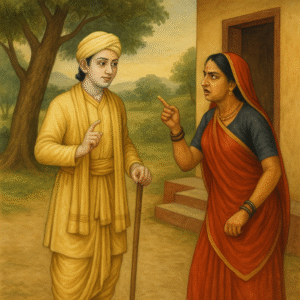
In the divine drama of Yāvat, two characters often appear as obstacles to the loving union of Śrī Rādhā and Śrī Kṛṣṇa — Jaṭilā, the mother of Abhimanyu, and Kutilā, his sister. Yet these figures are not ordinary beings; they are manifestations of Yogamāyā’s design, serving the eternal play of divine love.
Jaṭilā’s very name comes from the Sanskrit word jaṭa, meaning entangled. Her hair was knotted in a great tangled mass on her head, and her mind was equally twisted with constant suspicion — always trying to catch Rādhā and Kṛṣṇa in some imagined wrongdoing.
Kutilā, whose name means crooked, mirrored her mother’s nature. She was sharp-tongued, always scheming, and perpetually trying to prove herself right. Yet both of them, though appearing to oppose Rādhā and Kṛṣṇa, were actually servants of Their pastimes, adding flavor, tension, and sweetness to Their eternal love.
THE DIVINE PURPOSE BEHIND OBSTACLES
In spiritual life, the obstacles we face often act as Jaṭilā and Kutilā — testing our devotion and strengthening our love.
Just as these two women tried to keep Rādhā and Kṛṣṇa apart, the material world tries to keep the soul separated from Kṛṣṇa through distraction, pride, and doubt.
But the wise know that even these obstacles are servants of the Lord, helping the devotee turn inward and deepen remembrance.
Without Jaṭilā’s suspicion, Rādhā and Kṛṣṇa would not have needed to meet in secret; and without Kutilā’s crookedness, Their union would not have carried the sweetness of hidden love.
Thus, in the divine plan, every opposition becomes an instrument of affection, every trial becomes a dance of divine play.
LESSONS TO BE LEARNED
The Achāryas teach that Jaṭilā represents the entanglement of material attachment, and Kutilā represents the crookedness of envy and pride.
Both live in the mind of every conditioned soul.
When our hearts are ruled by suspicion, comparison, or the desire to control others, we behave like Jaṭilā and Kutilā — trying to interrupt the Lord’s natural flow of love in our lives.
But when we learn to surrender, to laugh at the crookedness of our own mind and allow divine love to act freely, we become like the sakhīs of Rādhārāṇī — helping the soul meet Kṛṣṇa through devotion, not through control.
Even the faults we carry, when offered to Kṛṣṇa with humility, can serve His purpose, just as these two apparent obstacles serve His divine play.
REFLECTIONS
Every heart contains a Rādhā longing for Kṛṣṇa — and also a Jaṭilā and Kutilā trying to stop that meeting.
But the Lord’s love is stronger than all our resistance.
In the end, even our entanglements and crooked thoughts can become part of His plan, if we let love triumph over fear.
This pastime reveals the tender truth that in Vṛndāvana, even apparent enemies are devotees — playing their roles to enrich the rasa, the divine taste of love.
PRAYER
O Śrīmatī Rādhārāṇī, purest queen of Vṛndāvana, please untangle the knots of my heart as You did with Jaṭilā’s suspicious mind.
O Śrī Kṛṣṇa, beloved of Rādhā, straighten the crookedness of my thoughts and words, as You lovingly did through Your playful leelas.
May every obstacle I face become a step closer to You.
May every doubt be transformed into faith, and every fear into the sweetness of surrender.
Origin: Lecture by HH Indradyumna Swami – “Śrī Rādhā’s Legendary Beauty – Yāvat Part 1,” 12 Nov 2025.