The Devotee’s Compassion
When Tukārām became a well-known devotee of the Lord, many people began to visit his home daily to hear harikathā — narrations about the pastimes of the Supreme Lord. His sweet words, filled with devotion, touched everyone’s heart. Gradually his reputation spread far and wide, and the village began to honor him as a saintly man.
Living near Tukārām was a scholarly brāhmaṇa who also had a few disciples. When he saw that his followers were leaving him and going instead to hear Tukārām’s discourses, he became filled with envy. Day by day his jealousy increased until it turned into hatred.
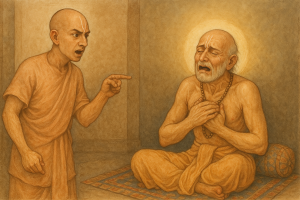
One night, unable to tolerate the praise that others gave to Tukārām, the brāhmaṇa decided to take revenge. He took a thick, thorny stick, hid himself in the darkness, and waited for Tukārām to pass by. When the saint appeared, walking peacefully and chanting the names of the Lord, the brāhmaṇa suddenly leaped out and began to beat him mercilessly. Thorns pierced Tukārām’s flesh, and blood flowed, but he uttered not a single harsh word. When the brāhmaṇa’s anger was spent, he returned home, leaving the injured saint lying in the dust of the road.
The Saint’s Reaction
Tukārām could not move for a long time. At last, he dragged himself home, his body bleeding and sore. He lay awake the whole night, unable to sleep because of the pain — not the pain of his wounds, but the pain in his heart. He thought, “Why did that brāhmaṇa beat me? Surely I must have hurt him somehow. Otherwise, why would he act in this way?”
The more he thought about it, the more he became convinced that the fault was his own. “I must have offended him without realizing it,” he reasoned. “Therefore he punished me for my own good.” In his pure humility he concluded, “I am the offender, not he.” He resolved that when morning came, he would go to the brāhmaṇa’s house, fall at his feet, and beg for forgiveness.
The Transformation
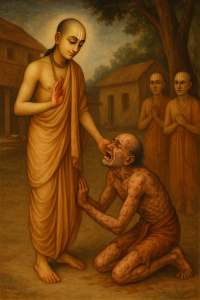
When dawn arrived, Tukārām struggled to his feet and went to the brāhmaṇa’s home, calling out gently for him. The brāhmaṇa, on the other hand, had spent the night in deep remorse. His conscience tormented him for attacking such a holy man. Opening the door, he saw Tukārām standing there, bruised and bleeding. Before the brāhmaṇa could speak, Tukārām fell to the ground and cried out, “O respected sir! I am the lowest of all beings, a fool. I must have committed an offense against you; otherwise, why would you have beaten me? Surely you wished my welfare. Please, my master, tell me what wrong I have done so that I may correct it. Be merciful and forgive my offense.”
Seeing Tukārām’s humility and hearing his tearful words, the brāhmaṇa’s heart melted. Overwhelmed with shame, he fell at the saint’s feet and said, “O brother Tuka! It is I who have committed the offense. You are a great devotee, and I have hurt you out of envy. Please forgive me; otherwise, I have no hope of deliverance.” Both men wept and embraced, their hearts purified by forgiveness and divine love.
Reflection
This story reveals the true nature of a pure devotee’s heart. Even when unjustly attacked, Tukārām did not blame his aggressor but searched within himself, thinking only of his own faults. Such humility attracts the Lord’s grace more than any austerity or learning.
From this episode we learn:
- True saintliness lies in humility, not retaliation.
- Envy destroys devotion, while forgiveness awakens divine love.
- A devotee sees himself as the offender and others as instruments of God’s mercy.
When we cultivate such a mood of tolerance and introspection, the Lord Himself resides in our hearts and transforms pain into love.
Source: “Obstacles in Bhakti” by Vinod Bihari Das Babaji.