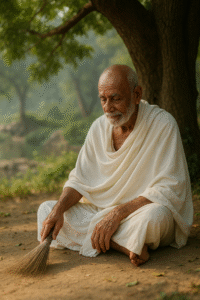
Śrī Gauracaraṇa Dāsa Bābā lived near the great temple of Daujī, the deity of Lord Balarāma, in the town of Baldeo (ancient Reṇukā). Every morning, he would go for darśana of the Lord, sing kīrtana with tears of love, and dance in front of the altar in ecstasy.
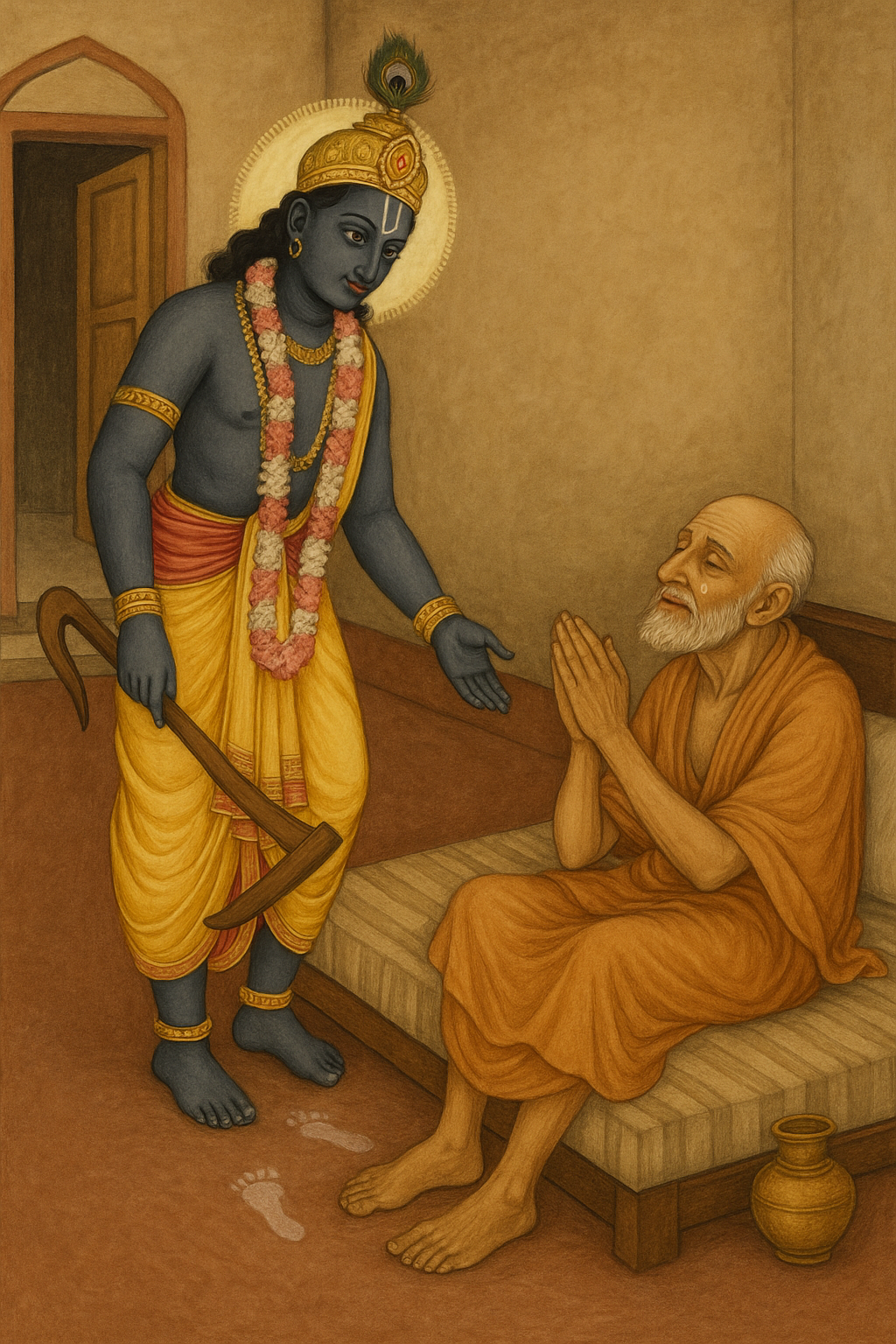
His whole day was filled with service and remembrance of Daujī. But one day, due to illness, his frail body could no longer move. Weak and feverish, he lay on his mat whispering, “O Daujī! I cannot come to see You today. Forgive me, my Lord.”
That night something miraculous occurred. The great temple of Daujī was locked as usual after the final evening ārati. Yet, when the priests arrived the next morning, they found the huge doors wide open, and the deity of Daujī was not upon His altar!
Panic spread through the temple. They searched everywhere, until someone noticed large footprints in the dust—leading out of the shrine, across the street, and all the way to the little hut of Gauracaraṇa Dāsa Bābā.
When they entered the hut, they saw the Bābā lying on his bed, his eyes overflowing with tears of divine joy. “My Daujī came to me,” he murmured softly, “He came Himself, because I could not go to Him.”
Soon after, the priests returned to the temple and found that the deity had mysteriously reappeared on the altar, His body glistening with perspiration and His feet covered with dust, as if He had indeed walked miles through the streets of Baldeo during the night.
Overwhelmed by awe and devotion, the priests began a new service tradition: every morning, they would wash Daujī’s feet and apply cool sandalwood paste, remembering His loving journey to visit His devotee.
The news of this incident spread far and wide, and pilgrims began to visit the temple not only to see the Lord’s majestic form but also to remember His tender love for His servant.
Reflection
When a devotee cannot go to the Lord, the Lord goes to the devotee.
Śrī Balarāma, the elder brother of Kṛṣṇa, is the personification of divine strength and compassion. Yet this story shows that His strength is not limited to might—He uses it to protect love itself.
For the devotee who is too weak to serve, the Lord Himself becomes the servant. Bhakti is not a one-way journey of the soul reaching God—it is the mutual movement of love, where both hearts seek each other.
Source: “Experiences in Bhakti: The Science Celestial,” by O. B. L. Kapoor — Chapter Five: Verification of the Law of Gravitation (place: Baldeo, near Mathurā, Vṛndāvana region).